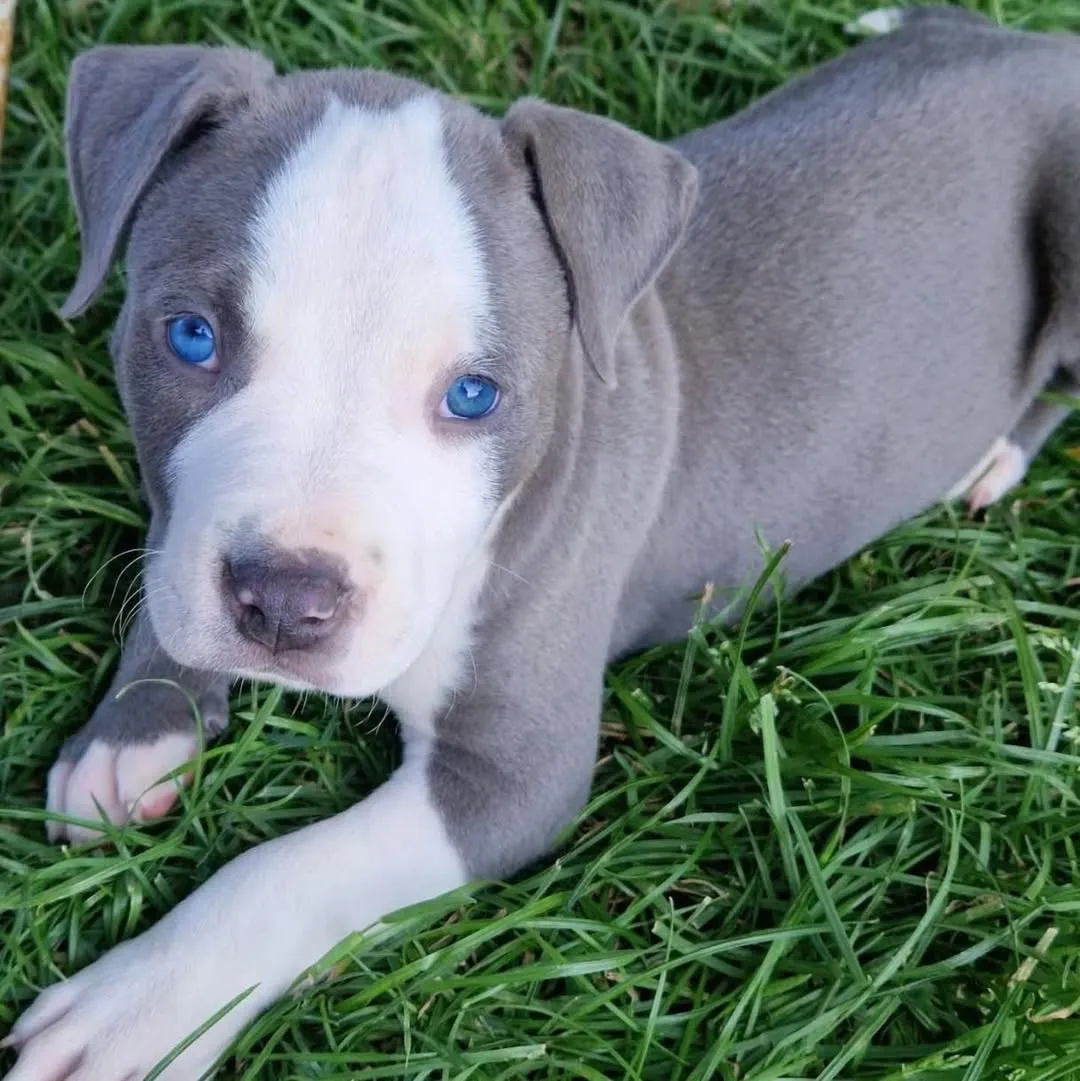
Roman Boy
Blue and white Available £1,500
Our blue-and-white boy, happiest stretched out on the grass.
- Vet-signed health card
- Microchipped
UK home delivery £200–£350 by distance, or collect in Carlisle
Meet Roman first £500 deposit reserves him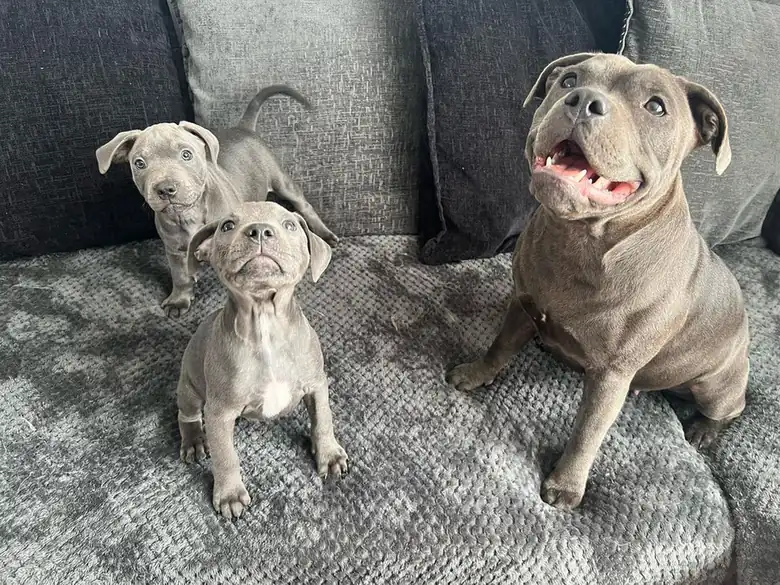
Five doors, weighed by a home breederCarlisle, Cumbria
How to choose a Staffy breeder starts with five doors: a home breeder, a licensed kennel, a marketplace advert, a rescue or a dealer. I am Lisa Bright, the home breeder in Carlisle, so my own row sits in the table with the rest.
What the Carlisle door asks and promises
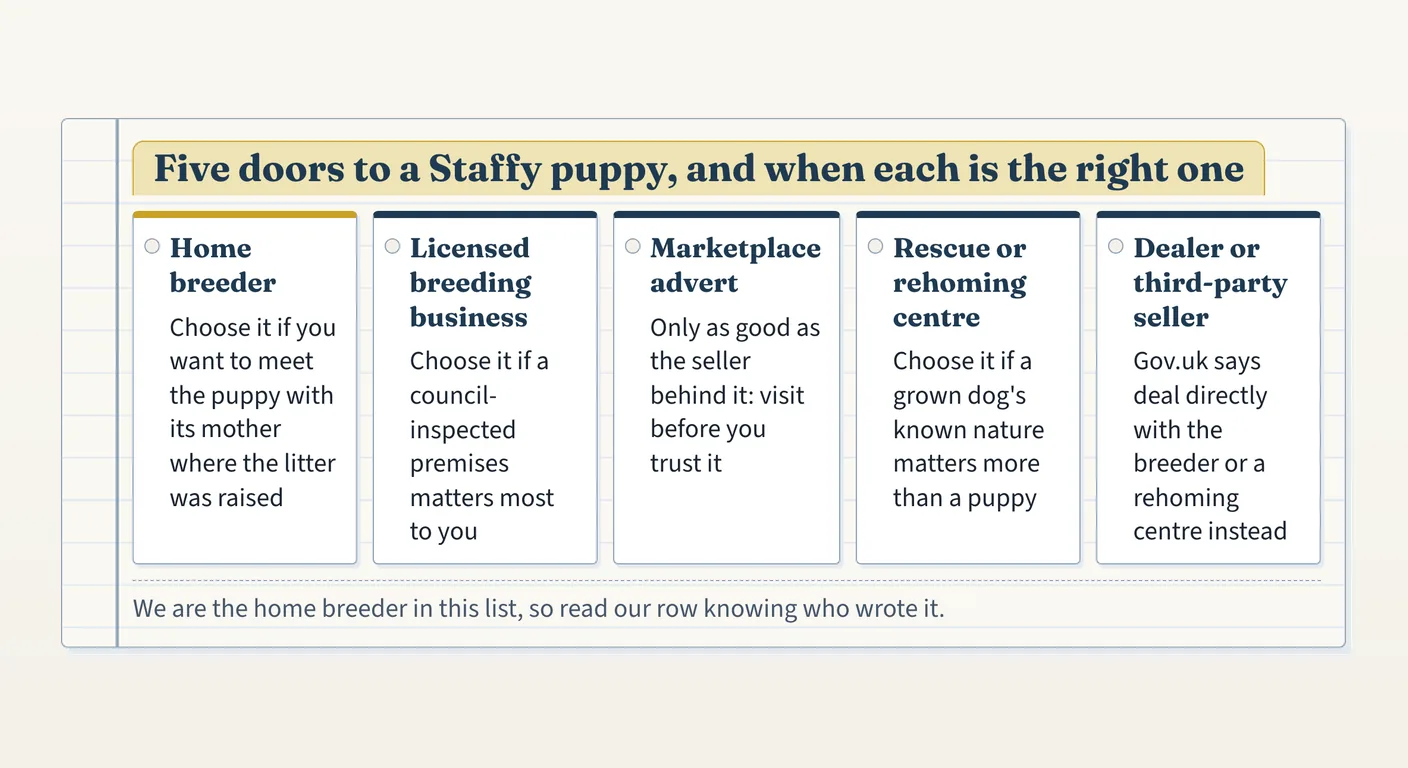
We lay out every route to a Staffy side by side, our own included, so you can see which door suits your household before you knock.
Try the door that lets you see the puppy with its mother where it was raised, read the terms in writing and check the papers first. For most families that is a home breeder.
A home breeder
if you want to meet the mother with her litter.
A rescue
if a grown dog's known nature matters more than a puppy.
A licensed kennel
if a council-inspected premises matters most to you.
How BlueStaffyUK compares to generic classified puppy ads is worth reading before you try any door.
FactThe home breeder's row from its records; the other doors quoted from gov.uk and the RSPCA
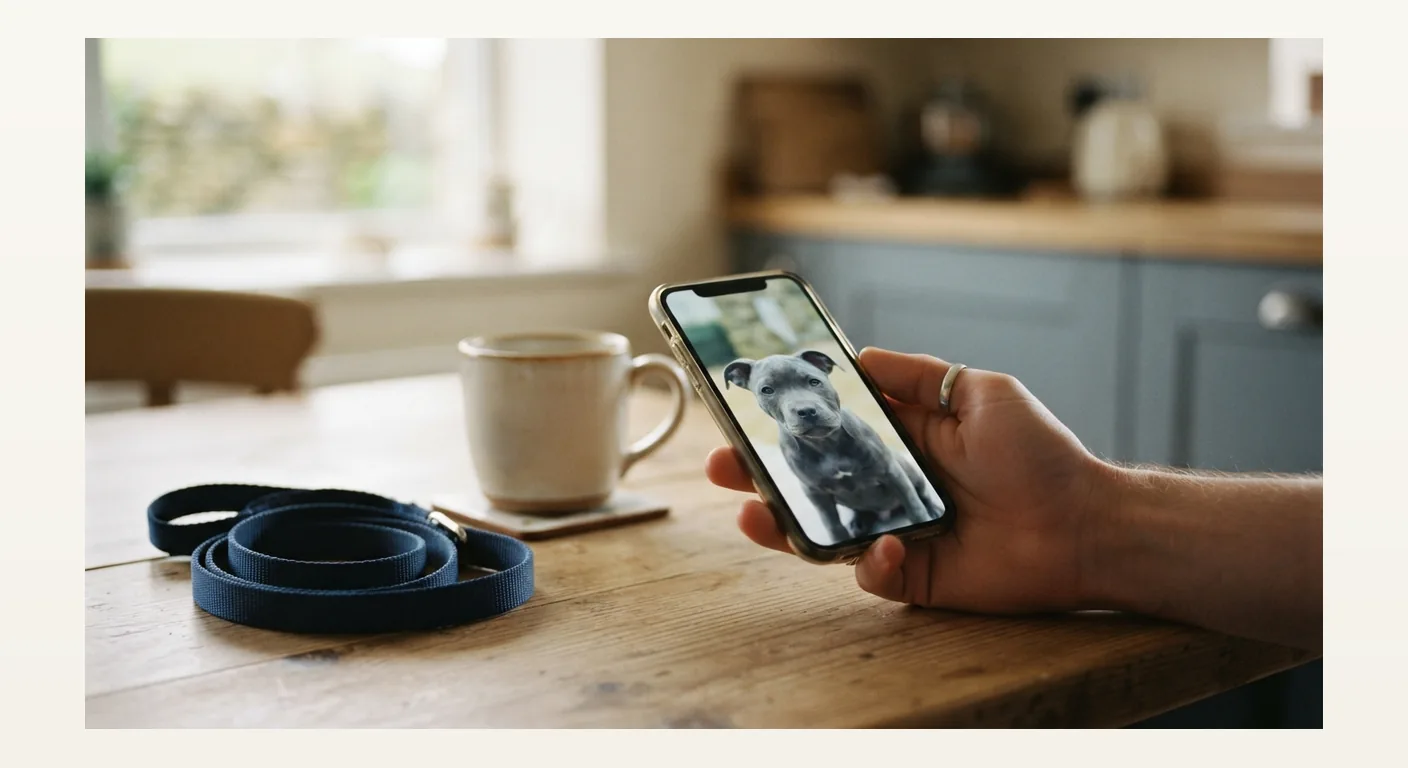
A screen can show you a pup and a price and nothing else, which is why we ask what each seller can show before money moves.
Very different amounts of proof. All five can put the same reassuring words in an advert; what each lets you see before any money moves is where they part, and the grid below shows it door by door. Each of the next five sections then takes one door.
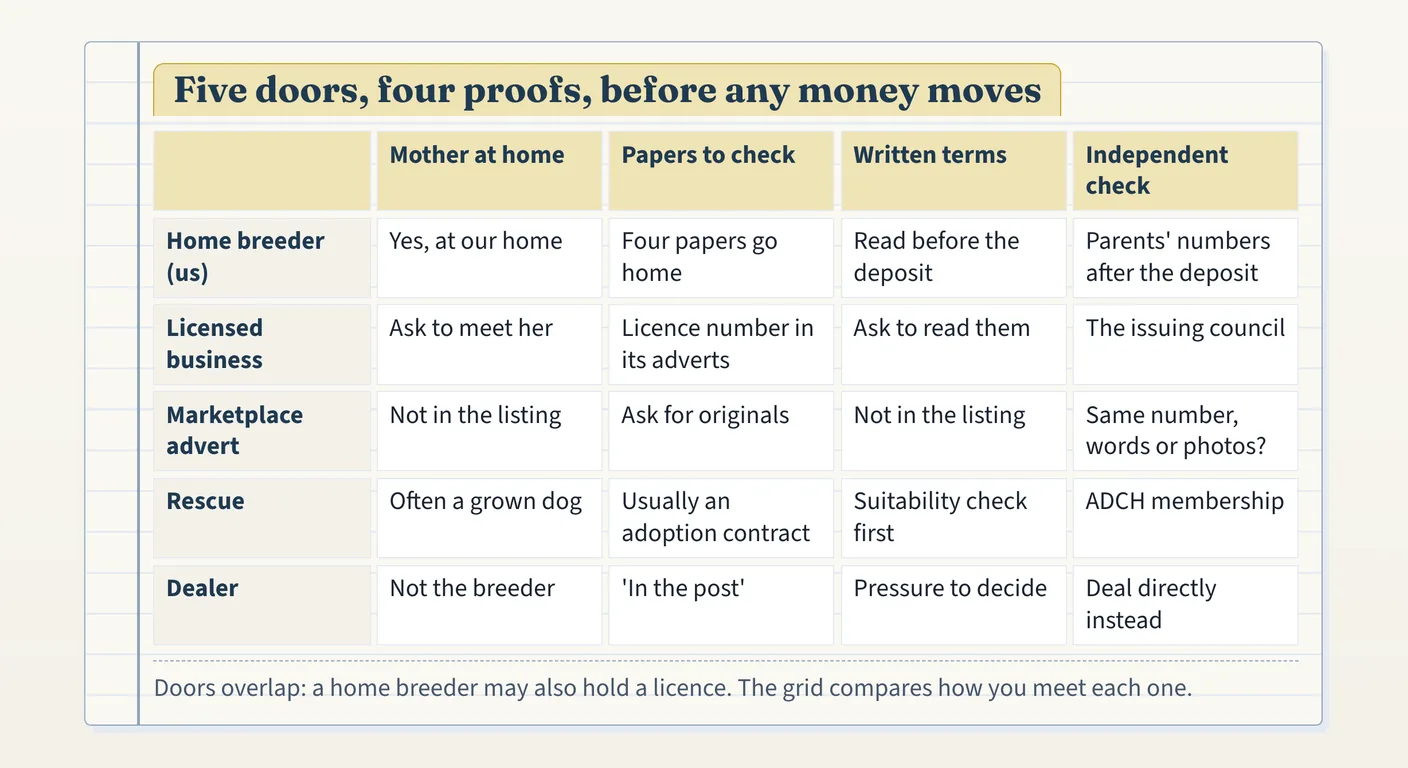
Read the grid across: the mother at home, papers you can check, written terms and an independent check, row by row for each seller.
Read along a row for one seller, or down a column for one proof. Papers get a section of their own further down.
| Door | Mother and litter at home? | Papers you can check | Written terms and aftercare | Independent check | Edge |
|---|---|---|---|---|---|
| Home breeder (us) | Yes: our litters grow up in our home, and you meet the mother with the litter | The Kennel Club registration application form, vaccination records, microchipping details and our written puppy purchase contract | You can read our contract before the deposit, and we take a puppy back if the fault is ours or its owner can no longer care for it; Two-year health guarantee | Both parents' registration numbers, after you pay the deposit; ask us about our licence | Depends on you: you meet the mother and the family that raised the litter |
| Licensed breeding business | Ask to meet the puppy with its mother, as gov.uk advises for any seller | Its licence number, which gov.uk says it must display in any advertising | Ask to read them before paying: a licence does not write them for you | The council that issued the licence can confirm it | A council inspection of the premises before the licence is granted |
| Marketplace advert | The listing cannot show it; only a visit can | Whatever the seller behind the advert holds: the RSPCA says ask for original documents | Whatever the seller offers; the advert itself promises nothing | The RSPCA's signs: the same number, words or photos on other adverts | Depends on you: an advert is only as good as the seller behind it |
| Rescue or rehoming centre | You meet the dog itself, often a grown dog | Usually an adoption contract, gov.uk says | Gov.uk: a good rescue checks your suitability first and offers ongoing support | Gov.uk: check the organisation is a member of the Association of Dogs and Cats Homes | A dog that needs a home, and a grown dog's character already known |
| Dealer or third-party seller | No: gov.uk says buyers must deal directly with the breeder or a rehoming centre | Papers 'in the post' are one of the red flags | Pressure to decide today is another | None to make: deal directly instead | None we can name |
Because there the better door turns on your household, not the seller. A family set on a puppy reads the rescue row one way; a family happy with a grown dog reads it another.
Every cell in the home breeder's row comes from the records the contract is written from, so the row cannot say more than the contract does.
Each government and RSPCA line is quoted in the section about its door, with the link beside it.
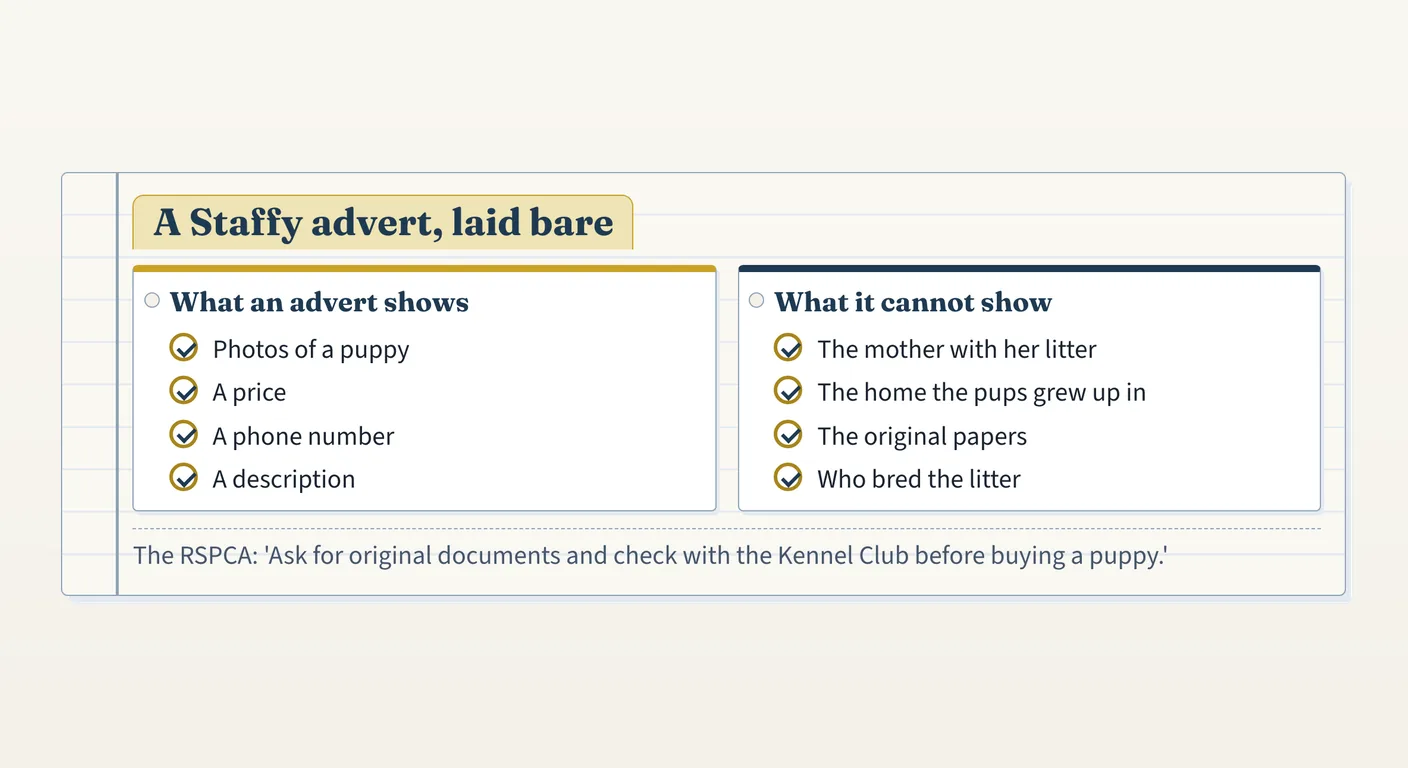
An advert proves there are photos and a phone number; we split what it can show from what it cannot, so the gap is plain to see.
A Staffy for sale advert proves that someone has photos of a puppy, a price, a phone number and a description. Nothing more. It cannot show the mother with her litter, the home the pups grew up in, the original papers or who bred them.
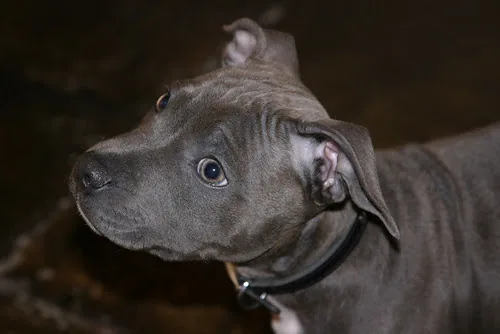
A glossy close-up like this can be lifted from anywhere, so we suggest checking where a listing photo first appeared before you reply.
A listing site is a noticeboard. Good photos and a fair price tell you about the camera, not the seller, and many adverts do lead to a real home. Only a visit tells you which.
Yes. The RSPCA warns that photos "may have been used in other adverts" and that descriptions may be "copied and pasted". Search both before you ring.
The same contact number on more than one advert is the first sign the RSPCA lists. Search the number too.
The RSPCA's own list of dealer advert signs adds that a puppy advertised with a passport "has most probably been imported", and it ends on the check worth making: "Ask for original documents and check with the Kennel Club before buying a puppy."
FactLisa Bright's own row, read from her records
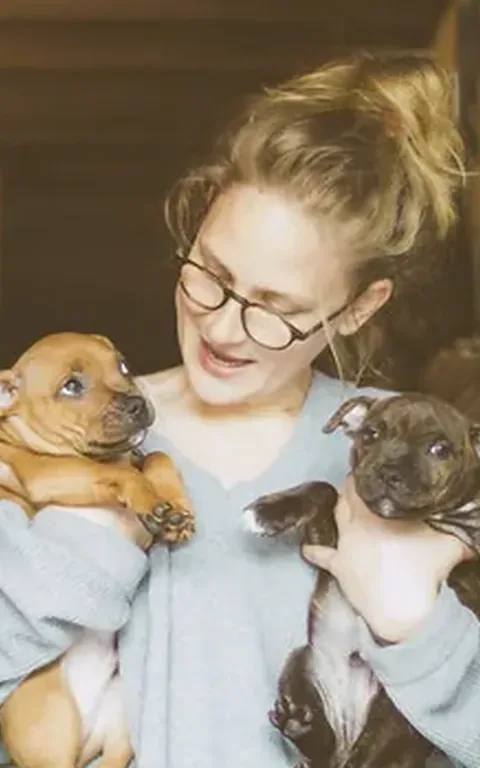
Lisa Bright holds the pups herself in this photo, which is the point: a breeder working from home should let you meet her and the house.
The mother with her litter, in the home they share, and every paper before you commit. We are one of the five doors, so read our row knowing who wrote it.
The breeder behind this row, and the house our litters grow up in, are on the About page.
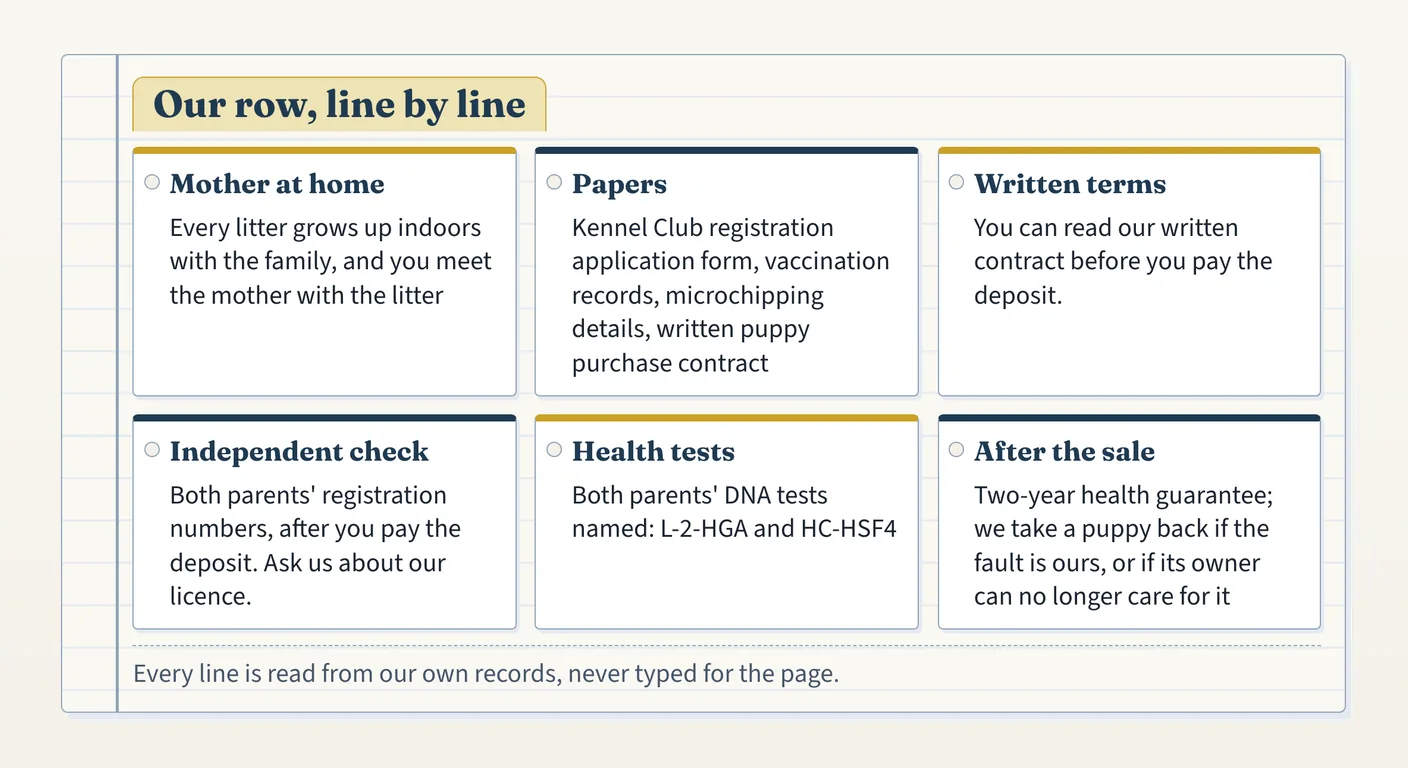
We answer our own row with the same six lines we ask of others: the mother, four papers, the contract, the parents, two tests, the guarantee.
Line by line, from the records in Carlisle. Every litter grows up indoors with the family, and you meet the mother with the litter. Maggie and Jones are both Kennel Club registered. They are both DNA tested for L-2-HGA and HC-HSF4; this page prints the names only, never an outcome. Before you decide, the vet who looks after our dogs will talk to you too. The four papers, the contract and the two-year health guarantee are set out further down. You can ask us about our licence.
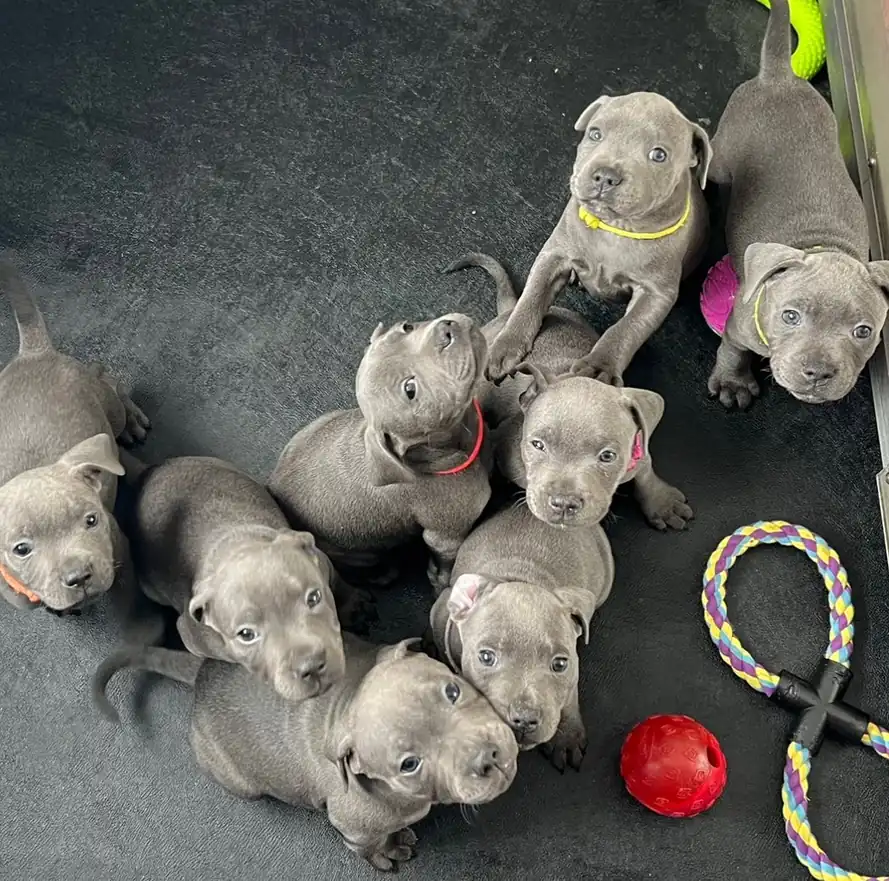
We plan one or two litters a year, so every pup like these eight is handled in the house rather than housed in a block outside.
Time with the pups. In Lisa Bright's words: We only get one or two litters a year, so we can spend plenty of time playing and interacting with the pups.
Indoors, in the family home in Carlisle, among the noise of an ordinary household rather than in a kennel block.
You come to the house, Maggie comes to the door with her litter, and you watch how she is with them and with you. Visit day is what the questions further down prepare you for.
Two things stay off this page. The DNA certificates are held back so nobody can copy them; they reach you after you make contact. No licence detail is printed either; ask about it.
The buying questions families in and beyond Cumbria ask first, about delivery, the contract and the visit.
No. Your puppy comes to your door by DEFRA-approved transport, priced by distance, or you collect it from Lisa Bright's home in Carlisle.
Nowhere. Home delivery runs £200–£350, set by the miles from Carlisle. Rather keep your address to yourself? A meeting point gets fixed the day before.
You read it in Carlisle before any deposit, for as long as you like. We take a puppy back if the fault is ours, or if its owner can no longer care for it, and that promise is part of our written contract.
After. You can meet the puppy with its mother at the family home before you pay any deposit, here at BlueStaffyUK in Carlisle. Only then does the £500 deposit reserve the puppy you chose, and the balance waits for collection day.
Yes. Each card on this page shows its pup's status from the breeder's own list in Carlisle, and that list changes the day a pup is reserved. Name the one you like and Lisa Bright confirms it first.

We quote the government's own wording on the licence rather than paraphrase it, because a buyer can check the source in a minute.
That a council has inspected the premises. The government's words: "The council will arrange an inspection of your premises before you get a licence." A licence is about the place and the conditions; it does not write your contract or meet your family.

Find the number in the advert, find the council that issued it, then ask that council to confirm it: three steps any buyer can take.
Two kinds of seller, in England. The government's dog breeding licence guidance applies to England and lists two cases: anyone who will "run a business that breeds and advertises dogs for sale" or "breed 3 or more litters in any 12 month period and sell any of the puppies".
In three steps: find the number, find the council, then ask it. The government says a responsible seller will show the number online, and "you can check this is legitimate with the local council".
A licence holder must "display the licence number in any advertising". No number in the advert, no check to run.
Gov.uk's find-your-council tool names the council for the address the seller gives you.
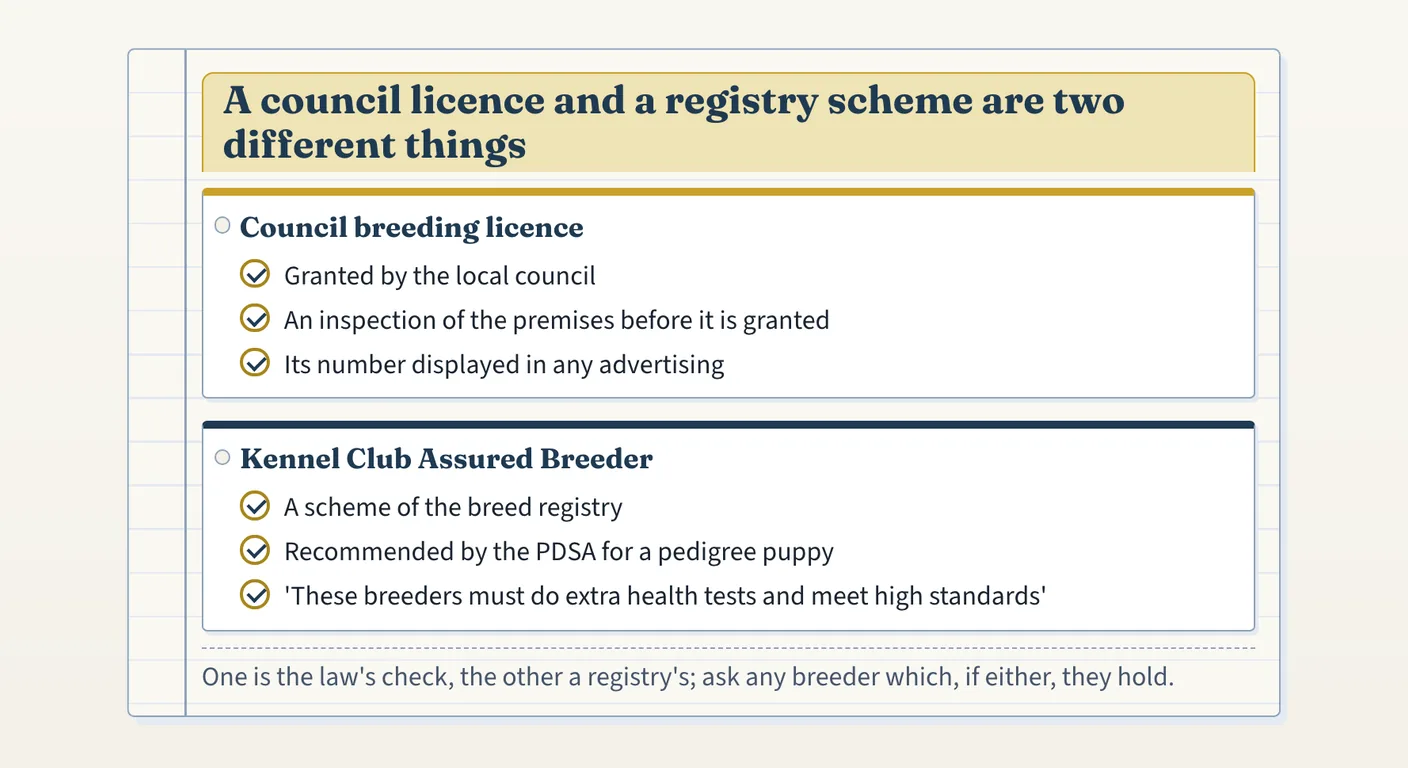
We set the two side by side because buyers often read one as the other; one follows a premises inspection, the other is a registry scheme.
Two different things. A licence comes from the council after an inspection; the Assured Breeder scheme belongs to the breed registry. The PDSA's Staffordshire Bull Terrier page recommends it for a pedigree puppy: "These breeders must do extra health tests and meet high standards." Ask any breeder which, if either, they hold.

We give a licensed kennel its due here: an inspection we cannot offer, set against the visit and the papers read first that we can.
On inspection. The council may also "carry out additional inspections at any time after it's granted", and that is a check a breeder's word cannot replace. A home breeder offers the visit itself instead, and the papers and contract read before money moves.
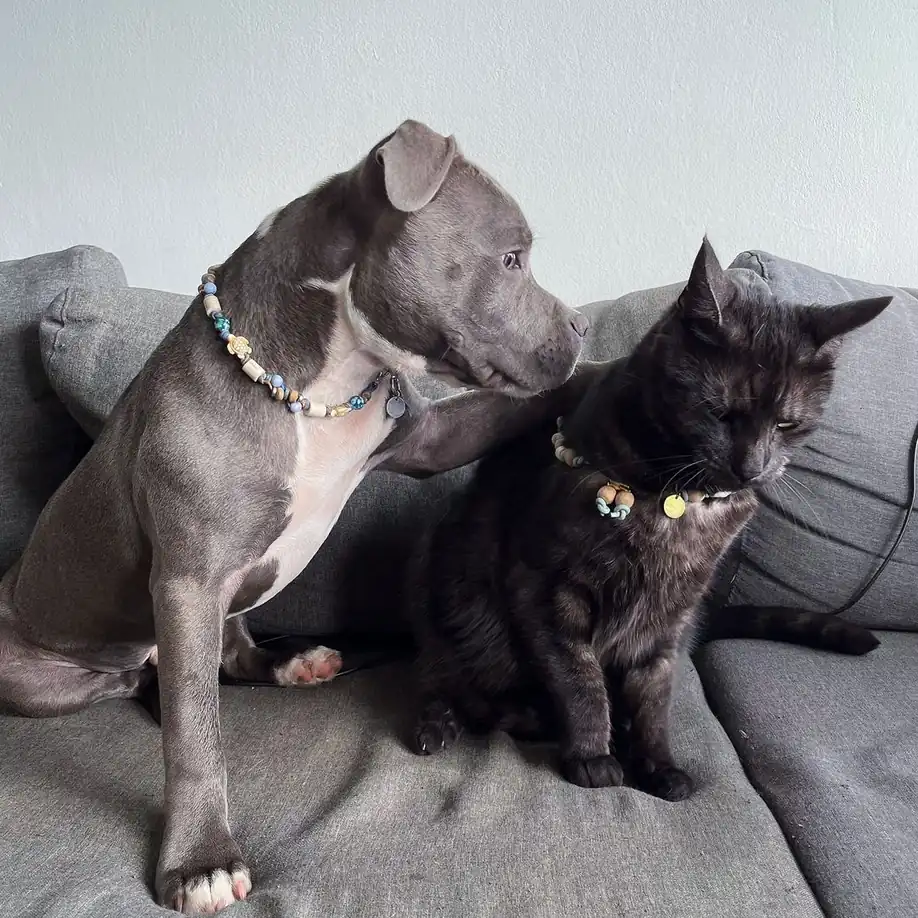
Sometimes the right answer is a grown dog who needs a home, and we would rather say so than talk anyone out of a rehoming centre.
When a grown dog suits your home better than a puppy does. A Staffy rescue gives a dog a second home, usually costs less than a puppy from a breeder, and lets you meet a character that is already formed.
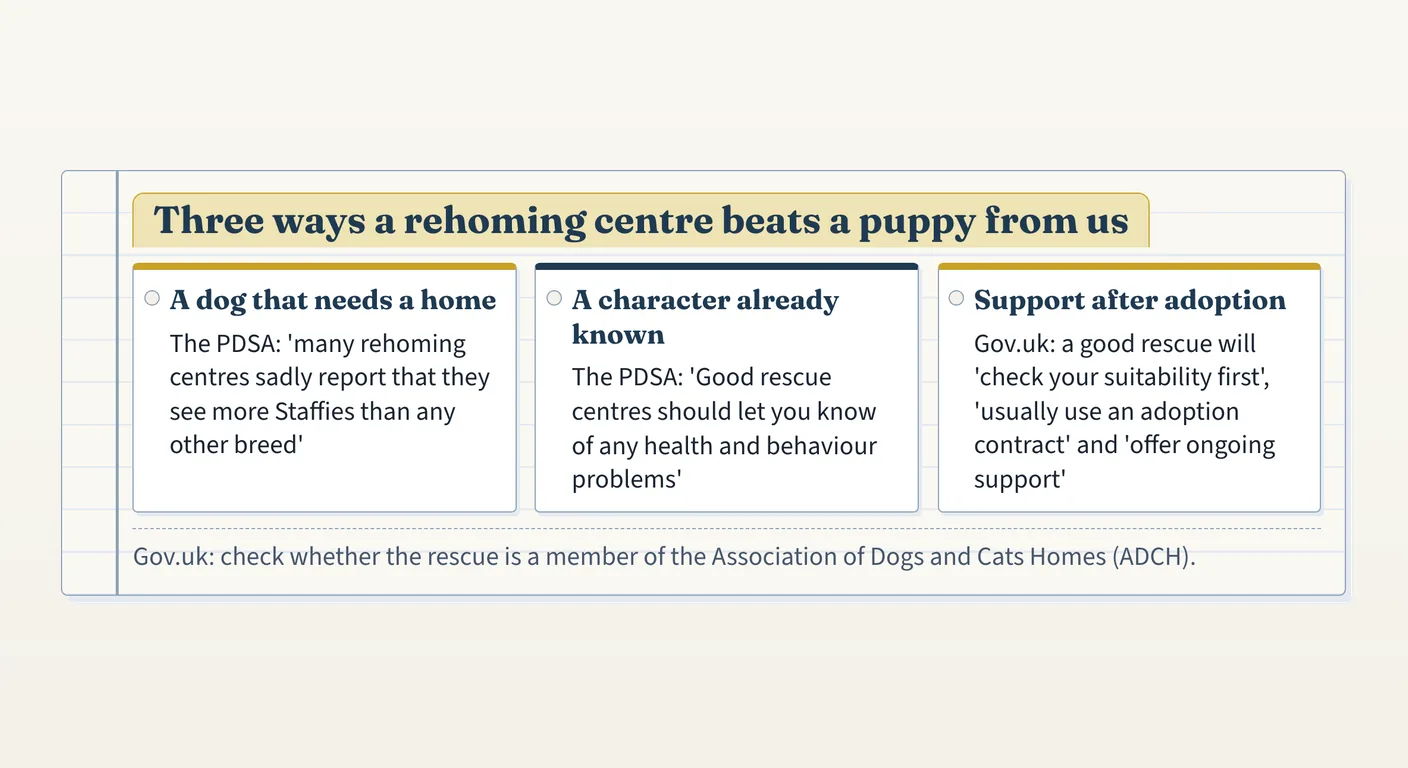
Each card quotes the PDSA or the government's guidance, so the case for a rehoming centre comes from them, not from a breeder.
A dog that needs a home
The PDSA: "many rehoming centres sadly report that they see more Staffies than any other breed".
A character already known
The PDSA: "Good rescue centres should let you know of any health and behaviour problems".
Support after adoption
The government: a good rescue will "check your suitability first", "usually use an adoption contract" and "offer ongoing support".
Dogs Trust's own Staffordshire Bull Terrier page is one rehoming charity's guide to the breed.
Often, yes. A first-time Staffy owner skips the chewing months and meets the dog as it will be.
A good centre tells you how a dog is with children, cats and being left, because it has watched it for weeks. With a puppy, you are reading its parents instead.
Gov.uk's advice on rescuing or rehoming a dog says to check whether the organisation is a member of the Association of Dogs and Cats Homes (ADCH). If a puppy is right for you after all, read on.
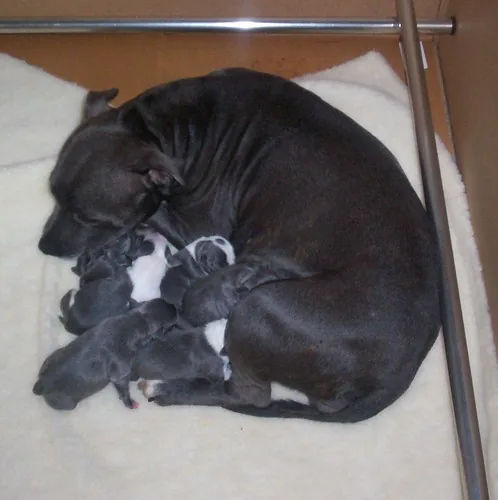
A seller who bred the litter can show you the mother with her pups, as here; a dealer cannot, because the mother was never theirs.
Any sign that the seller did not breed the litter. The RSPCA says some normal-looking homes are "a shopfront" for puppy dealing rings. Each sign below is one I pass, so test me with them too.

Any one of these eight is reason to slow down; two or more together and we would walk away, however good the pup looks.
Because a third party puppy seller stands between you and the litter, and the government's advice is to cut that step out.
The government's advice: a responsible seller will "never sell a kitten or puppy younger than 8 weeks old". Visit questions come further down, and a pup handed over on the first visit skips them.
The government's advice on buying a dog puts it plainly: "Anyone looking to buy or adopt a kitten or puppy must deal directly with: the breeder, a reputable UK rehoming centre".
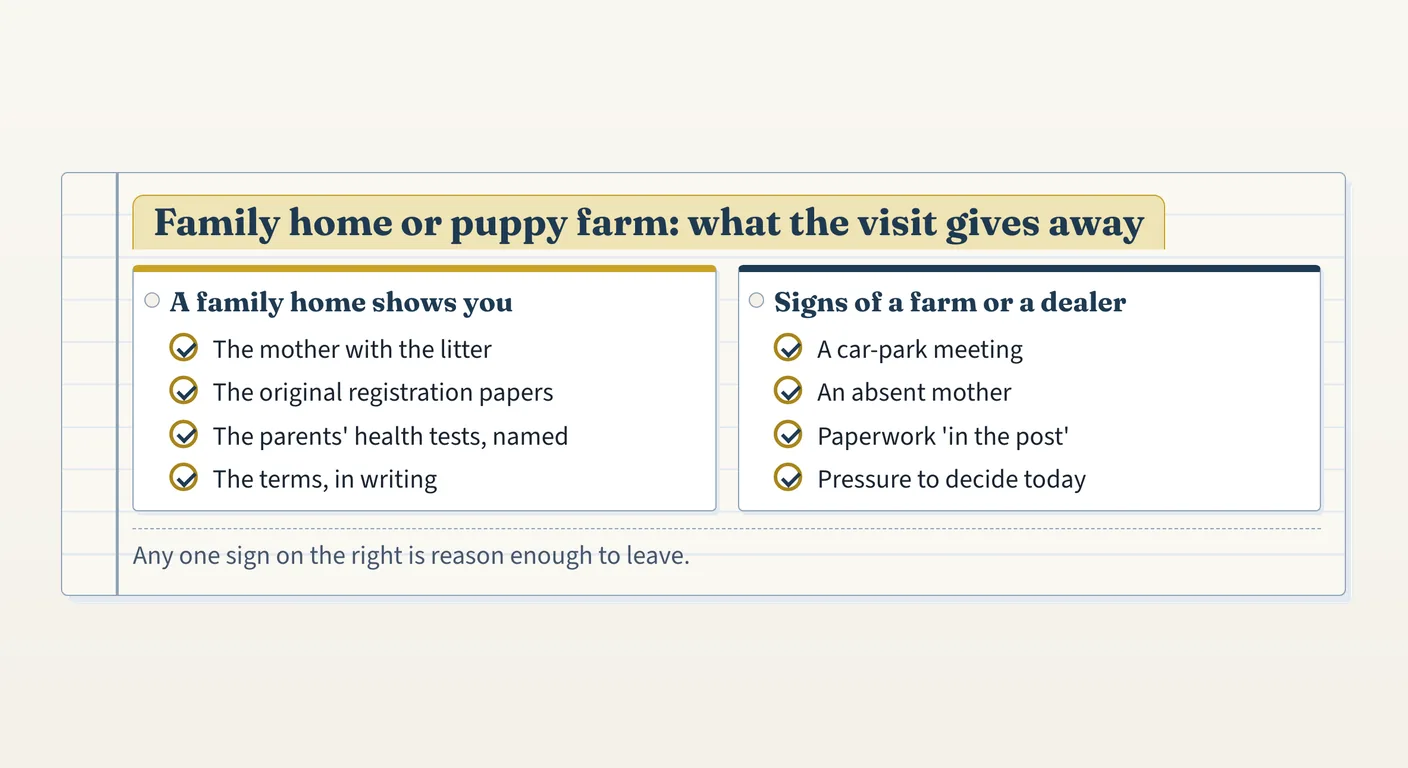
A car-park meeting, an absent mother and papers promised in the post tell you more than anything the seller says on the phone.
A family home shows you the mother with the litter, the original registration papers, the parents' tests by name and the terms in writing. A car-park meeting, an absent mother, paperwork in the post or pressure to decide today points to a farm or a dealer. Any one is reason enough to leave.
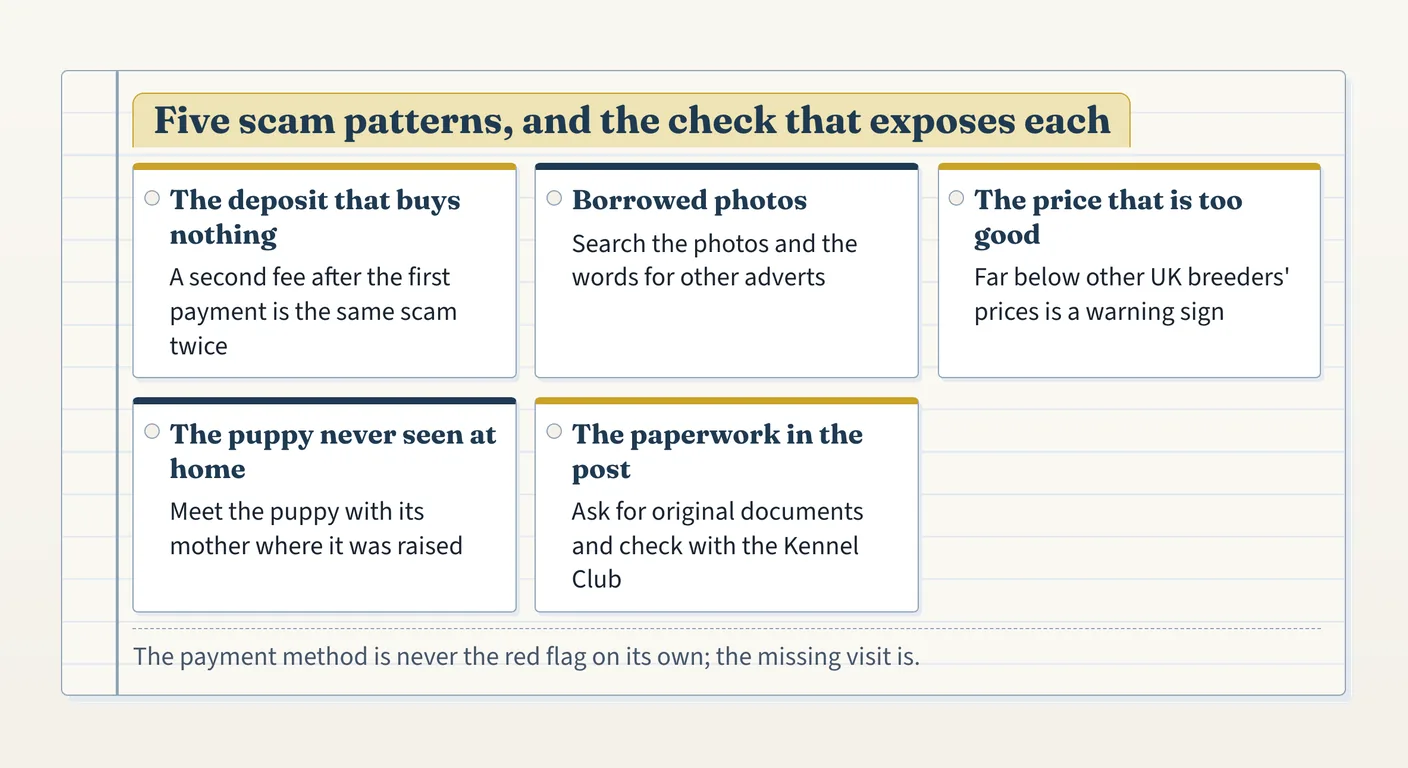
We pair every scam with the check that exposes it, so the card works as a list you can run through before any money leaves your account.
Five, and each has one check that exposes it. The payment method is never the warning sign on its own; the missing visit is.
The deposit that buys nothing
A second fee after the first payment is the same scam twice.
Borrowed photos
Search the photos and the words for other adverts.
The price that is too good
Far below other breeders' prices is a warning sign.
The puppy never seen at home
Meet the puppy with its mother where it was raised.
The paperwork in the post
Ask for original documents and check with the Kennel Club.
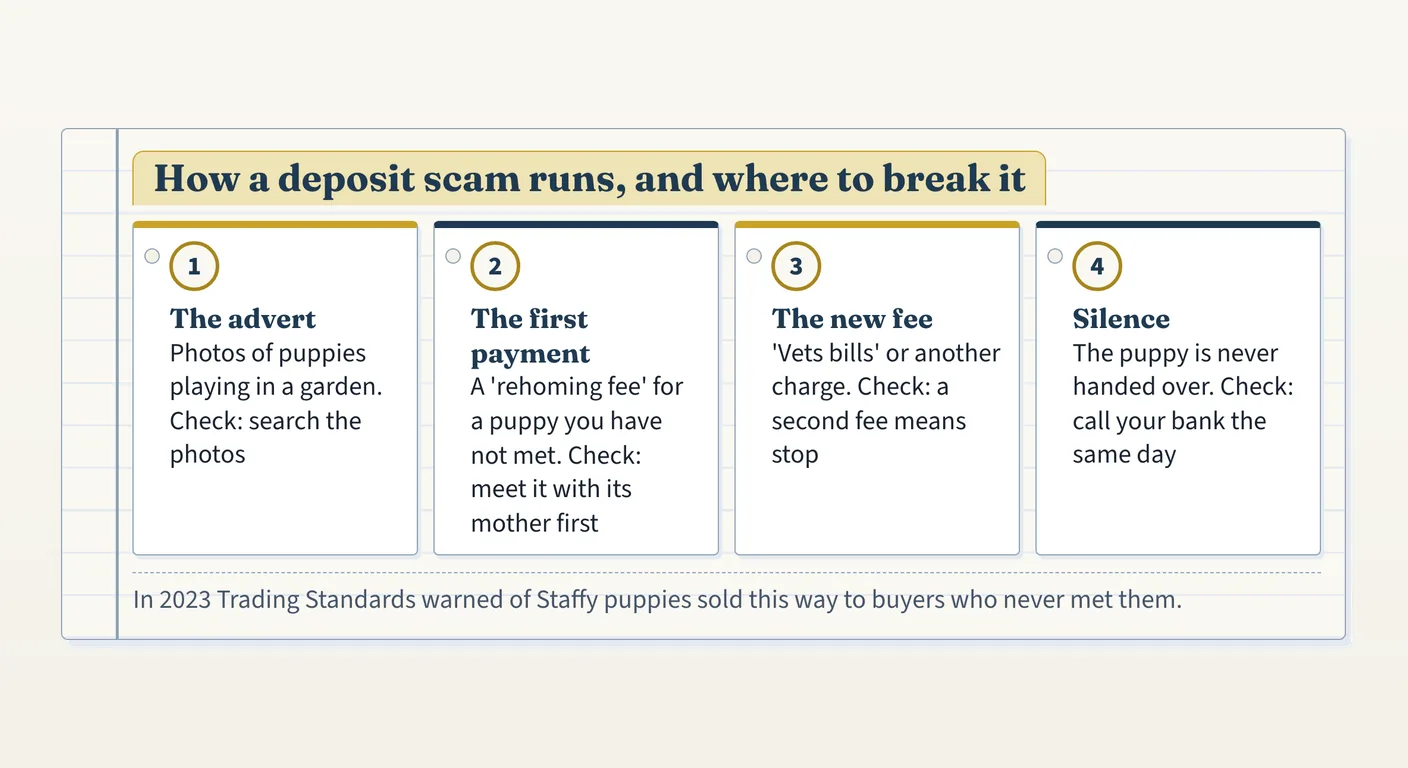
The chain only works if the first payment goes before you have seen the pup with its mother, which is the link we tell buyers to break.
As a chain: an advert of puppies playing in a garden, a first payment for a pup you have not met, a new fee, then silence. In 2023 the Chartered Trading Standards Institute warned of Staffy puppies sold this way, with a "rehoming fee" followed by "vets bills".
Another charge appears: vet bills, a courier, insurance. Then the puppy is never handed over.
A second fee means stop. Pay nothing more, and call your bank the same day.
The deposit here is £500. It reserves the puppy you have met, it comes off the price, and it is up to 70% refundable if you change your mind up to 1 day before collection or delivery. Nothing else is asked for until collection day.
Sometimes. A search finds a photo lifted from another advert, but one owner warned that it "isn't reliable in the age of AI", so treat it as one check, not the only one.

If money has gone, call your bank first, the same day, then report it, and keep every message and payment record from the seller.
Your bank first: call at once and say the payment went to a scam. Then report it to Action Fraud, the national fraud reporting centre. Keep the advert, the messages and the payment record, and report it even if the sum is small, because the same advert may still be running.
FactThe parents' health tests, named, with no outcome printed
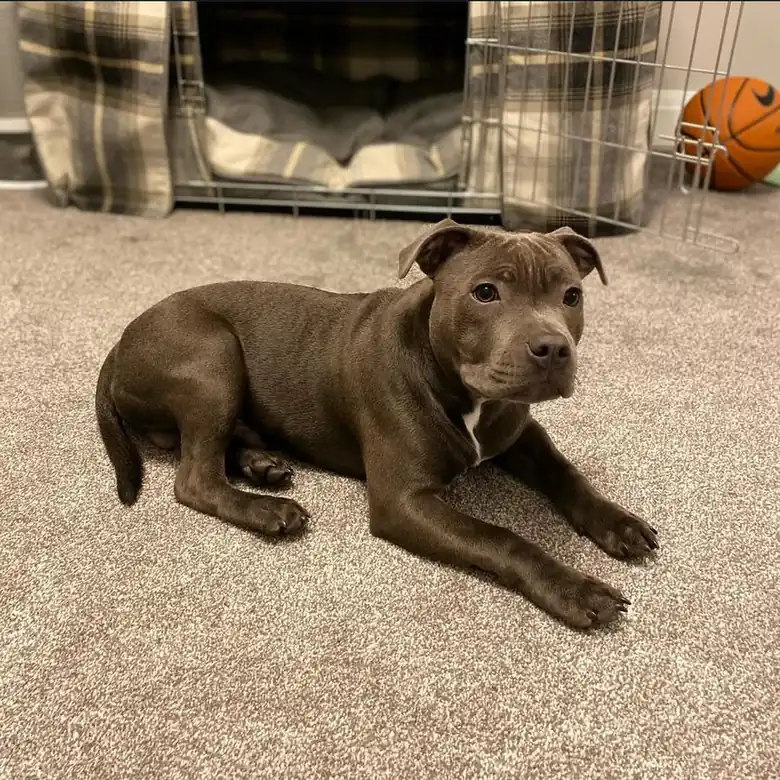
Ask about the father as well as the mother; we tell every buyer about Jones, though he is the parent people most often forget to ask after.
Seven before you go, and the rest at the visit itself. The Royal Kennel Club's own breeder questions are a good independent list; ours are shorter and work for any seller.
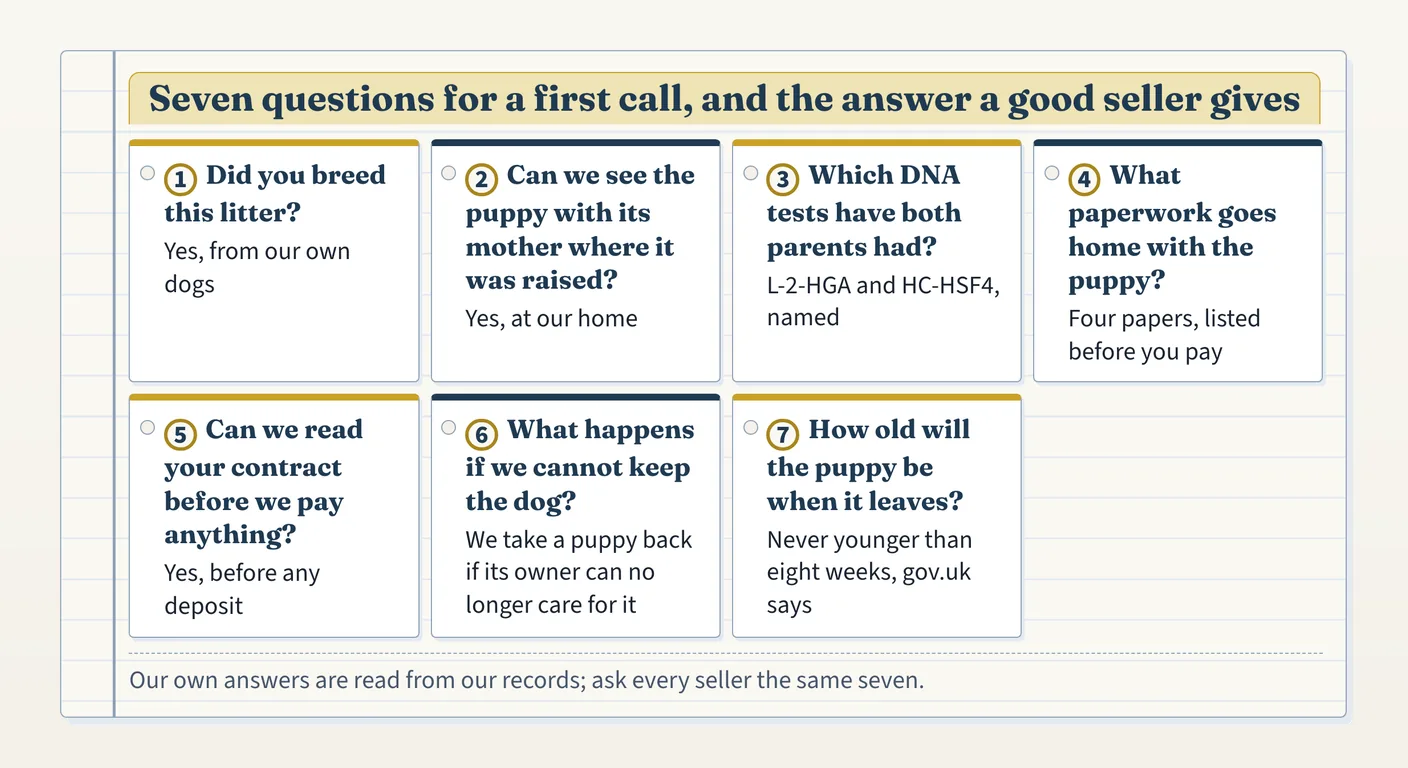
Each question comes with the answer a good seller gives, so you can hear a weak reply for what it is while you are still on the phone.
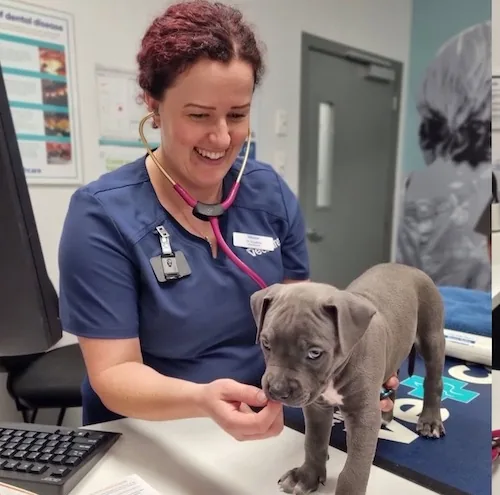
At the visit, ask to read the pup's own health card and the parents' paperwork; a good seller shows both gladly.
The mother's manner, the vet-signed health card, how the pups have been socialised, and the guarantee in writing. Paperwork for each door is set out in the next section.
Here at BlueStaffyUK in Carlisle, our two parent dogs are DNA tested for L-2-HGA and HC-HSF4. L-2-HGA is a metabolic condition affecting the brain; HC-HSF4 is an inherited cataract. Ask any breeder you speak to which tests the parents had, and expect both names back.
What each of the two DNA tests can and cannot rule out is on the BlueStaffyUK health page.
A named test is not a shown result. Both tests are named here, with no result printed.
The registry's L-2-HGA test page explains what the metabolic screening looks for.

The papers that travel home differ by route, so we show the folder first and then what each kind of seller should put in it.
It depends on the door, and the table shows which papers each one hands over and where you check them.
| Door | Papers that travel home | Where you check them |
|---|---|---|
| Home breeder (us) | The Kennel Club registration application form, vaccination records, microchipping details and a written puppy purchase contract, with the vet-signed health card | Both parents' registration numbers and papers, after you pay the deposit |
| Licensed breeding business | Its licence number, which gov.uk says it must display in any advertising | The council that issued the licence |
| Marketplace advert | Whatever the seller behind it holds | The RSPCA: ask for original documents and check with the Kennel Club |
| Rescue or rehoming centre | Usually an adoption contract, gov.uk says | Whether the organisation is a member of the Association of Dogs and Cats Homes |
| Dealer or third-party seller | Papers promised 'in the post' | Nowhere: gov.uk says deal directly with the breeder or a rehoming centre |
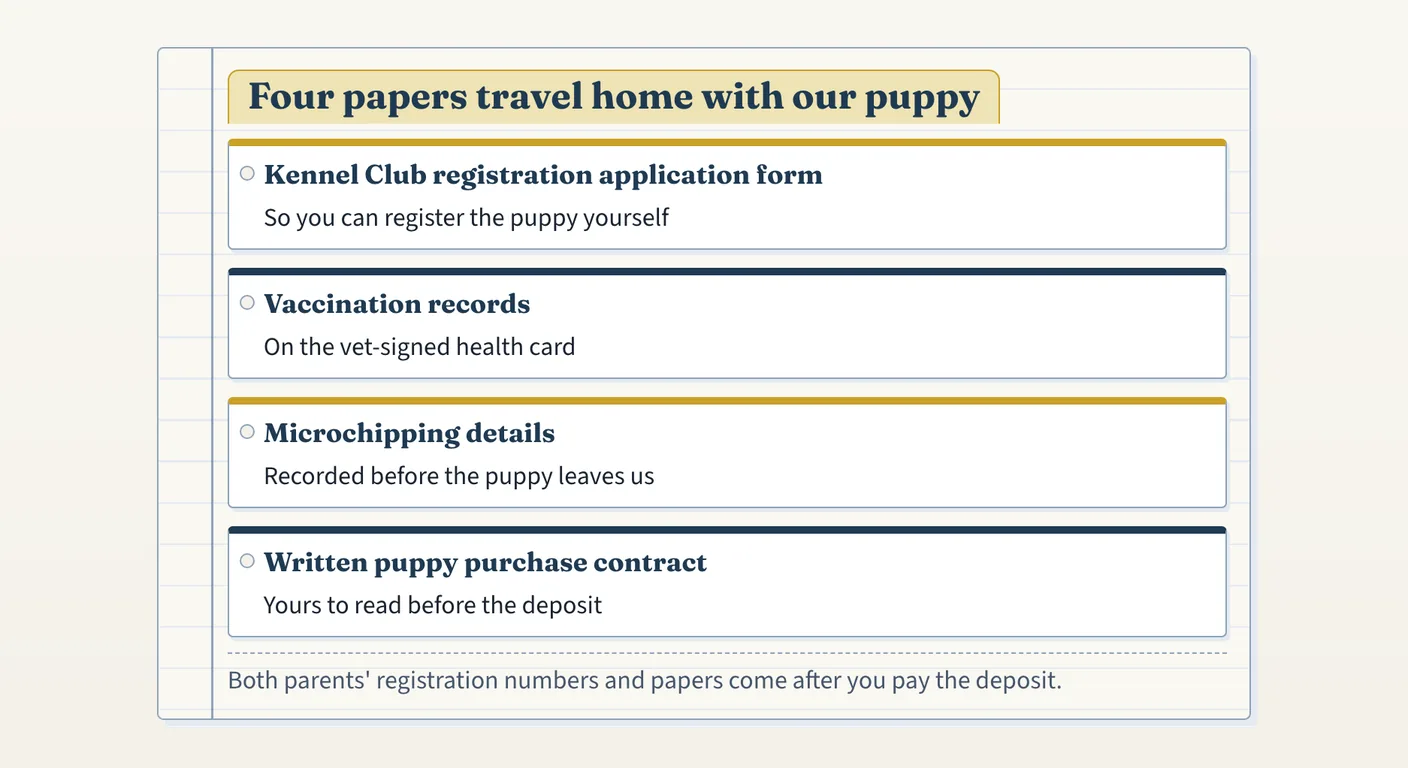
Every one of our puppies goes home with the same four papers, and we list them so you can tick each off at our table before you leave.
Four papers. The Kennel Club registration application form, so you register the puppy yourself; the vaccination records on the vet-signed health card; the microchipping details; and our written puppy purchase contract, yours to read first.
Everything that leaves our home with a puppy, item by item, is listed on the sale page.
Ours is, and its microchipping details go home in the folder.
The form handed over is an application: you send it in, and the puppy is registered in your name. Registration is also how the breed itself is settled, as the next section shows.
Gov.uk's microchipping guidance is the source for the rule; the government's buying advice says a responsible seller will "have a puppy microchipped and registered from 8 weeks old".
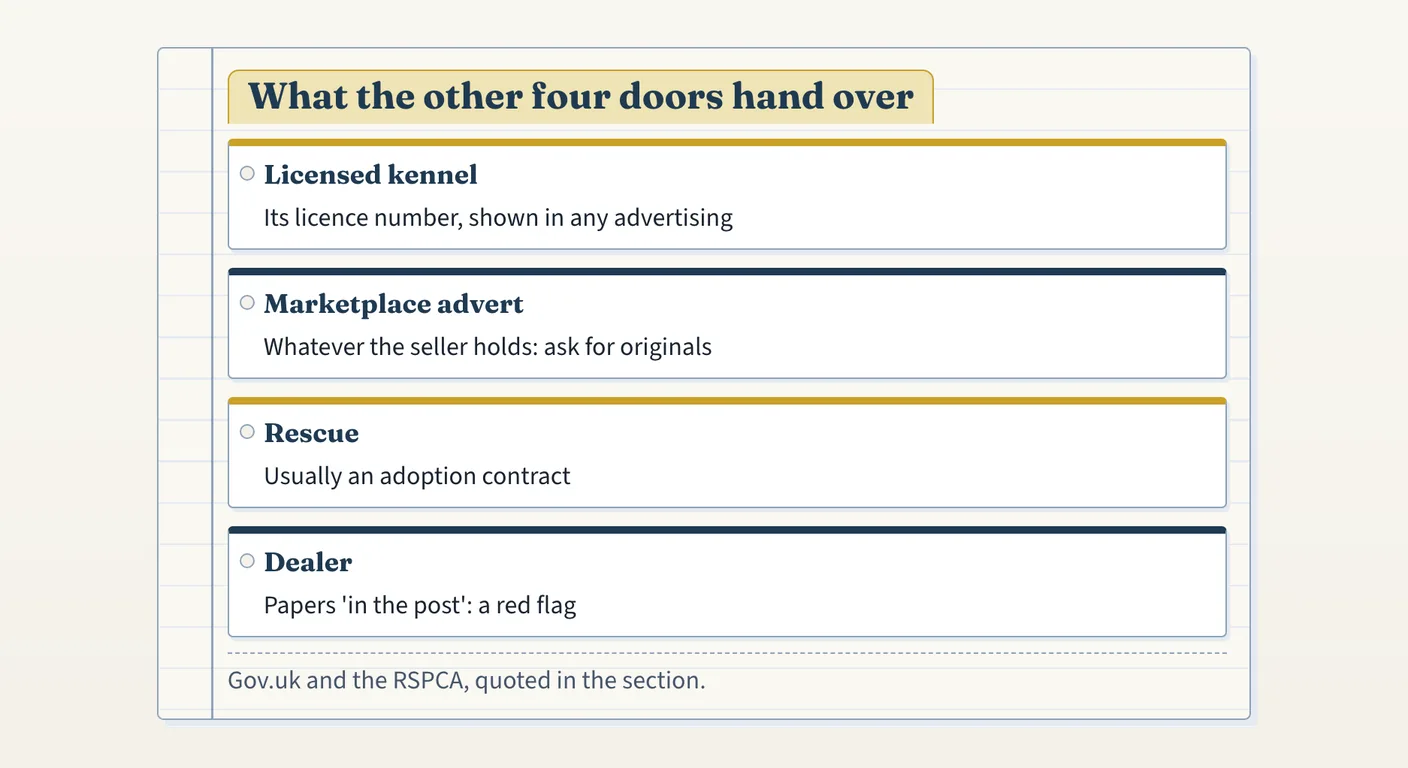
A licence number, an adoption contract, papers you must ask for, or papers promised in the post: each route hands over something different.
A licensed kennel shows its licence number in its adverts. An advert gives you whatever the seller holds, so ask for the originals. A rescue usually uses an adoption contract. A dealer's papers are "in the post", which is a red flag in itself.
FactBreed registration and the government's banned-dogs list
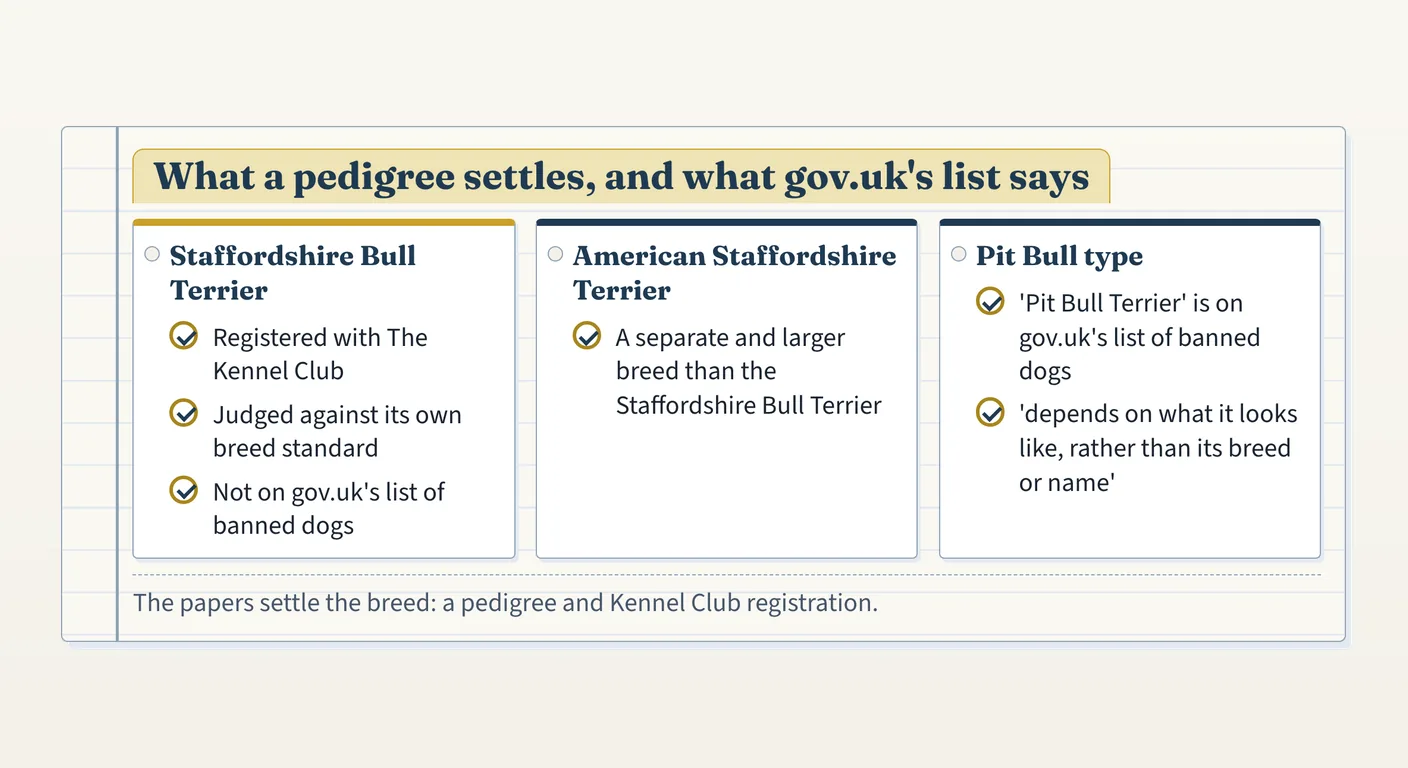
Registration papers name the breed, which matters when a seller's Staffy might turn out to be an AmStaff or a Pit Bull type instead.
The breed. A Staffordshire Bull Terrier breeder registers each litter with The Kennel Club, and the pups are judged against their own breed standard; a look-alike carries no such pedigree.
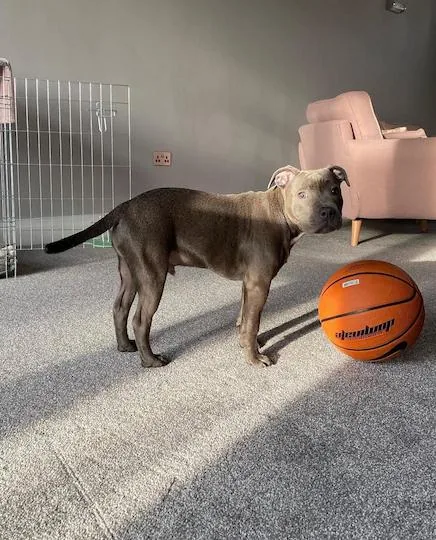
A pedigree settles which breed a pup belongs to; looks alone cannot, since a young Staffy and its look-alikes can be hard to tell apart.
A pedigree settles the breed. The American Staffordshire Terrier is a separate and larger breed. All three are dogs of one species, Canis familiaris, but a Pit Bull is a type, not a pedigree breed, and the government's list of banned dogs names the "Pit Bull Terrier" while the Staffy is not on it. The government's banned-dogs list goes by how a dog looks, not by its breed or its name, so the papers are worth keeping safe.
The breed's own story, from Bulldog and terrier roots onward, is told in the breed guide. Where an American Bully parts company with a Staffy has its own comparison page.
The parents' tests, the guarantee and the support after collection, answered from Lisa Bright's own records.
FactFrom the breeder's records: the tests by name, the guarantee, the aftercare
Two conditions. Our dam and sire are DNA tested for L-2-HGA and HC-HSF4. The first is a metabolic condition that affects the brain, the second an inherited cataract; we name the tests and print no outcome.
A two-year health guarantee comes with every BlueStaffyUK puppy from Carlisle. Ask us for the full terms before you pay a deposit. It covers health issues and birth defects for two years from the day your puppy comes home.
A veterinary health check, a first vaccination, a microchip, worming and flea treatment. Each one goes on a vet-signed health card that travels home with the puppy.
Every sale. Each puppy goes home with a written puppy purchase contract, and the take-back promise in the first block of questions is one of its clauses.
Us. Write in the first week or any week after: a question asked after the handover gets the same care as one asked before it, from us rather than an agency. I, Lisa Bright, reply myself from home in Carlisle.
The visit settles it. An ethical home breeder shows you the mother with her litter, names the parents' tests and puts the terms on paper. A car-park handover, a missing mother or papers "in the post" are each reason enough to walk away.
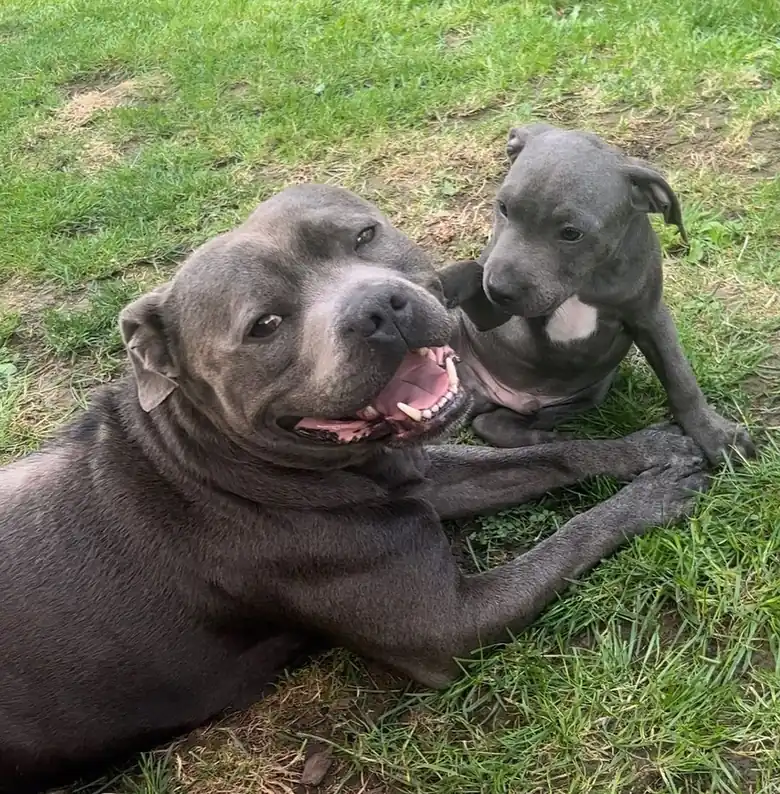
The grown dogs in a litter's family are the best preview of a pup's adult size, manner and energy, so ask to spend time with them.
A fair forecast of its temperament. A calm, friendly mother with her litter is the best sign you get at eight weeks, and Maggie and Jones were chosen for a settled nature as well as for their health tests.
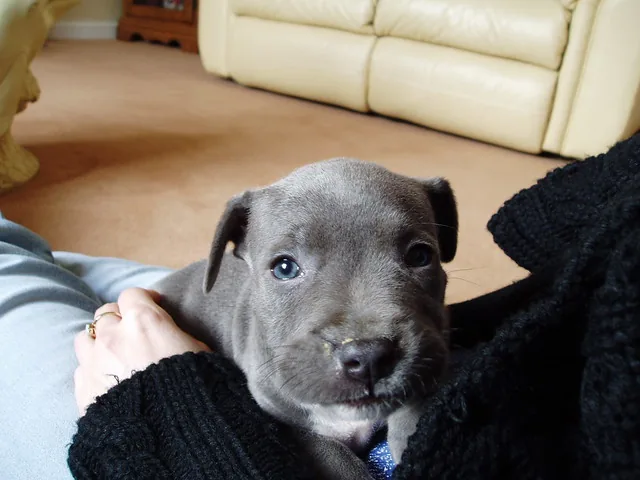
Her manner is the best forecast you will get: a calm, friendly mother tends to raise pups that settle in your arms like this one.
Watch how Maggie greets you and how she settles her pups. A Staffy bonds hard with its family and often with one person most, and a puppy raised among people takes that warmth with it.
Picking one pup from a litter you have just met is a guide of its own. The Blue Cross's advice on socialising a puppy covers the weeks after collection.
The PDSA gives a "Minimum exercise (per day)" of "1 hour". Split it into two walks with play, and a grown Staffy settles well at home.
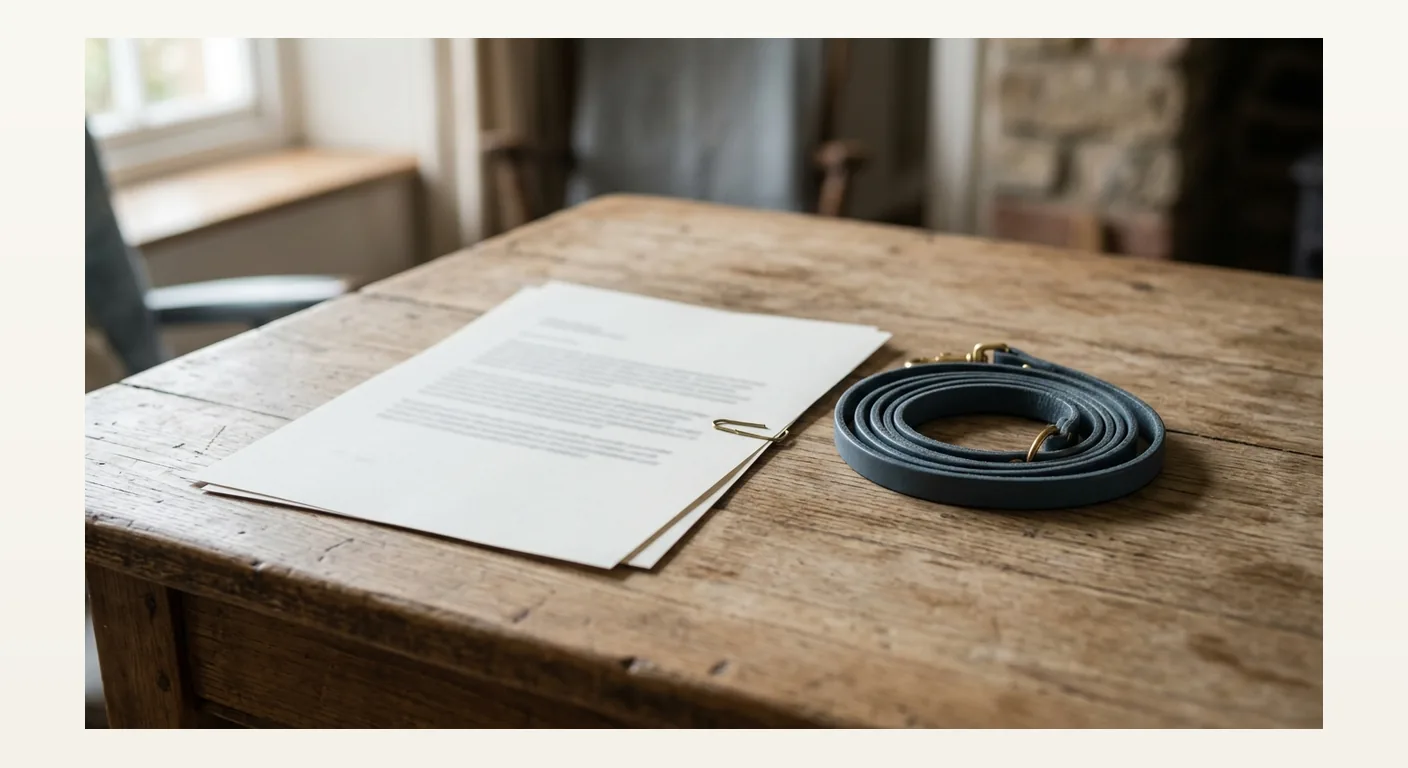
We send the contract before we take a deposit, so you read the terms at your own table and not in a rush on collection day.
Only once you have met the puppy and read what the money buys. Here that is a £500 deposit that reserves one named puppy and comes off the price. Both parents' papers follow it, and the rest is due on the day your puppy leaves us, whether you collect in Carlisle or we deliver.
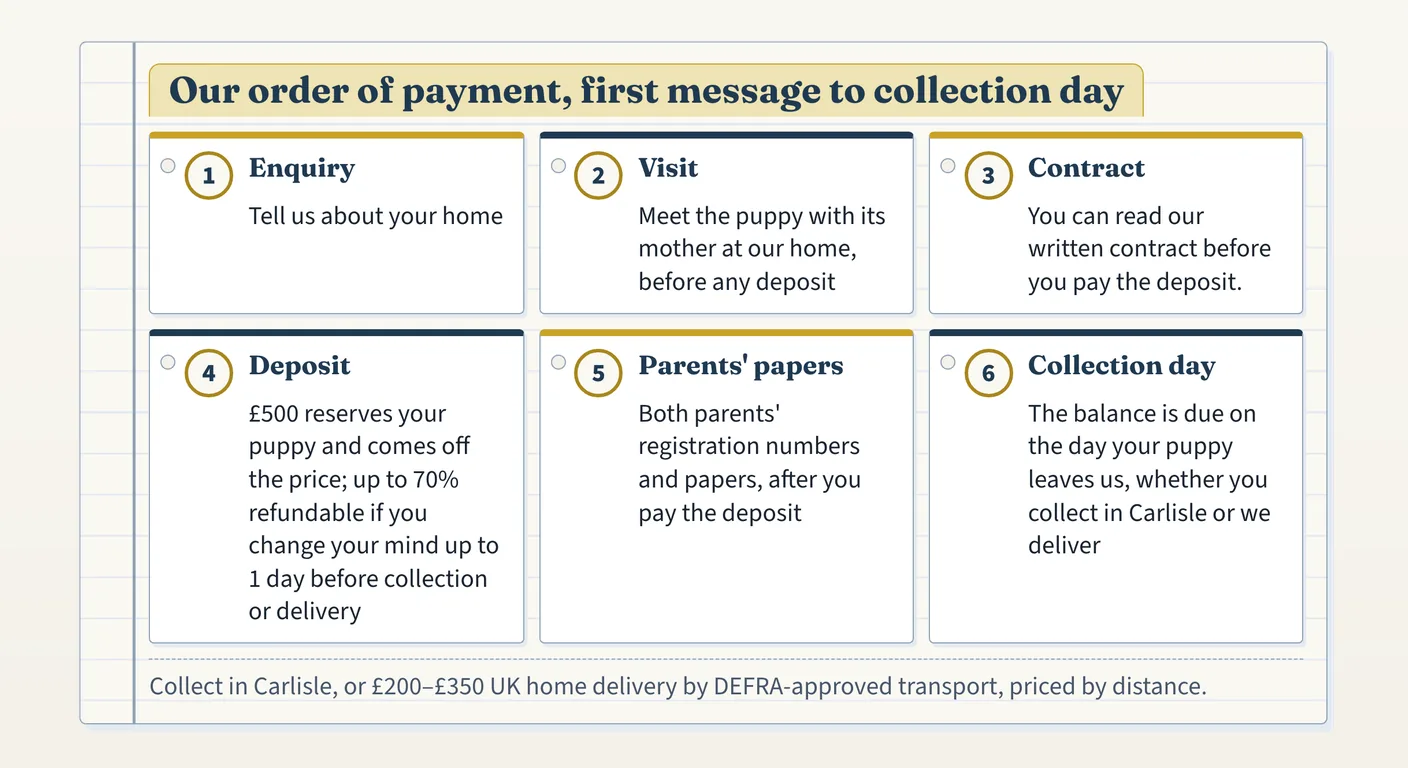
You meet the puppy with its mother before any deposit, and you see the contract before you pay it; nothing in our order runs the other way.
Enquiry, then a visit to meet the puppy with its mother at the family home in Carlisle, before any deposit. Then the contract, the deposit, the parents' registration numbers after you pay the deposit, and collection day. Collect in Carlisle, or we bring the puppy to you for £200–£350, priced by distance, by DEFRA-approved transport.
No. The contract comes first and names your puppy, and our two-year health guarantee covers health issues and birth defects for two years from the day your puppy comes home. A puppy bought as a pet needs neutering or spaying by two years of age.
If your plans change, the deposit is up to 70% refundable if you change your mind up to 1 day before collection or delivery.
Ask us to send the contract over before anything is paid and we will go through it with you.
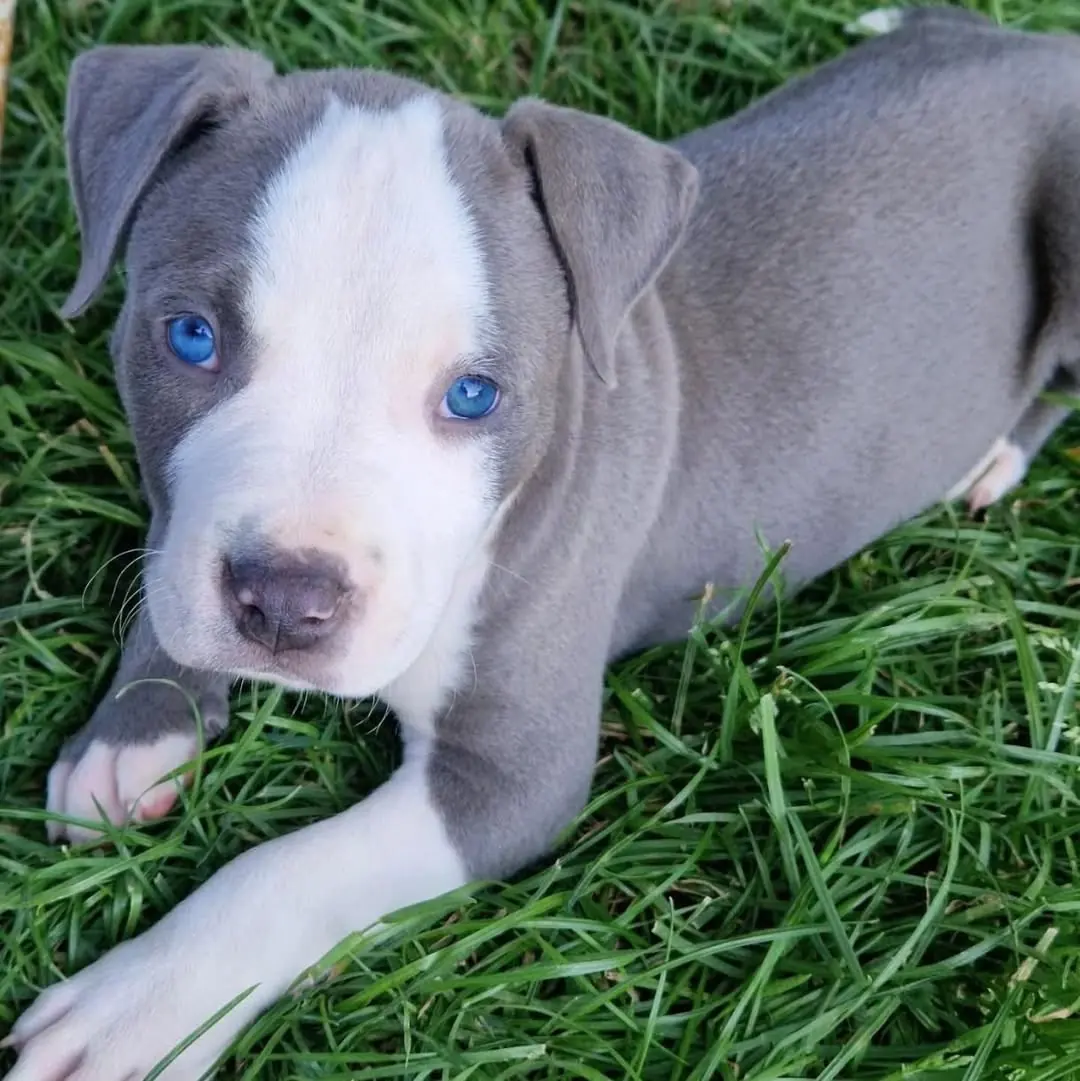
Roman is one of the six pups we have now, each priced from our own list rather than typed onto a page, so his card and his contract agree.
Six pups, three boys at £1,500 and three girls at £1,700, all from Maggie and Jones. Each card reads its price and status from the litter list in Carlisle.
No pup of ours matches that pair.
Roman Boy
Blue and white Available £1,500
Our blue-and-white boy, happiest stretched out on the grass.
UK home delivery £200–£350 by distance, or collect in Carlisle
Meet Roman first £500 deposit reserves him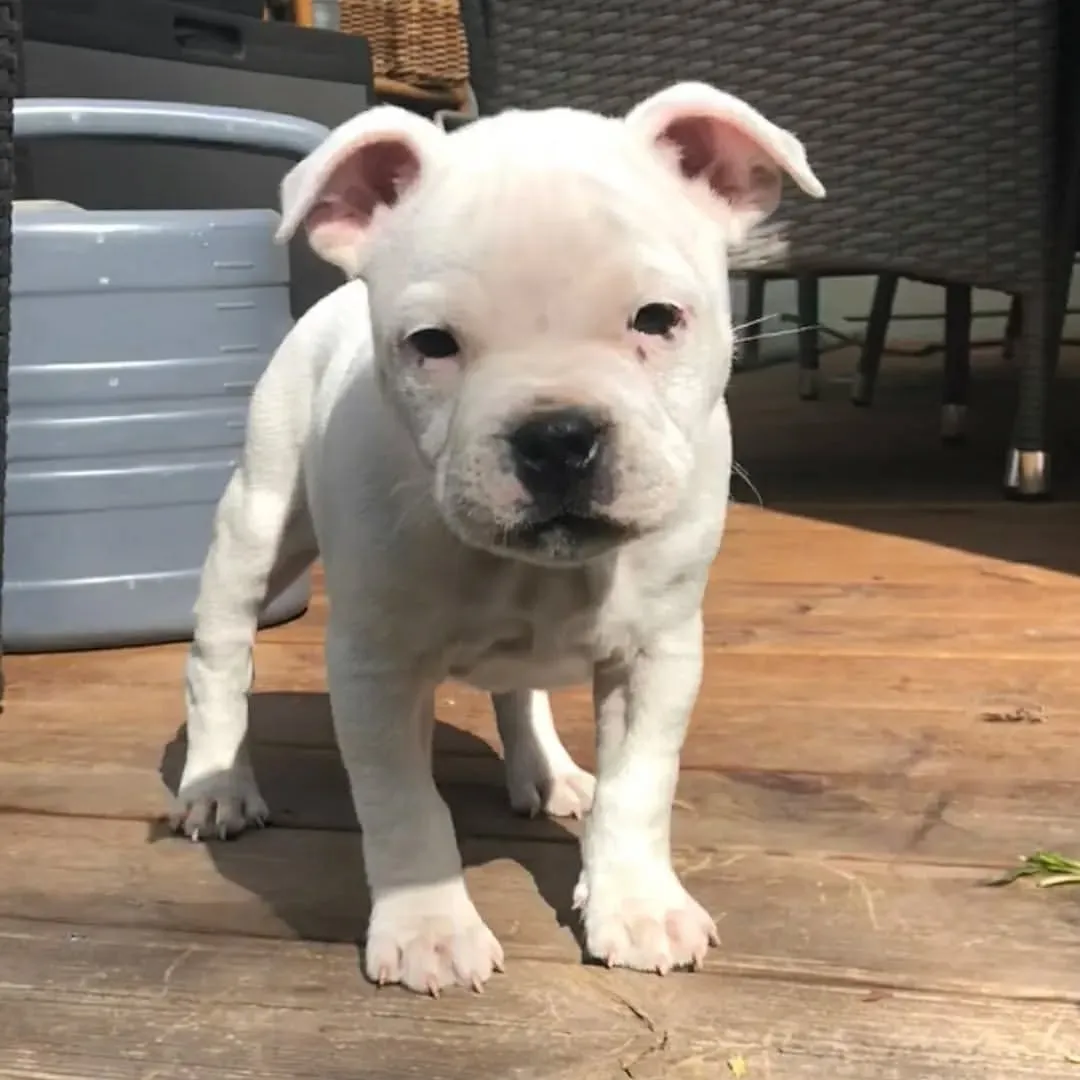
Byrd Boy
White Available £1,500
Our sturdy white boy, first to trot over and see who's come in.
UK home delivery £200–£350 by distance, or collect in Carlisle
Meet Byrd first £500 deposit reserves him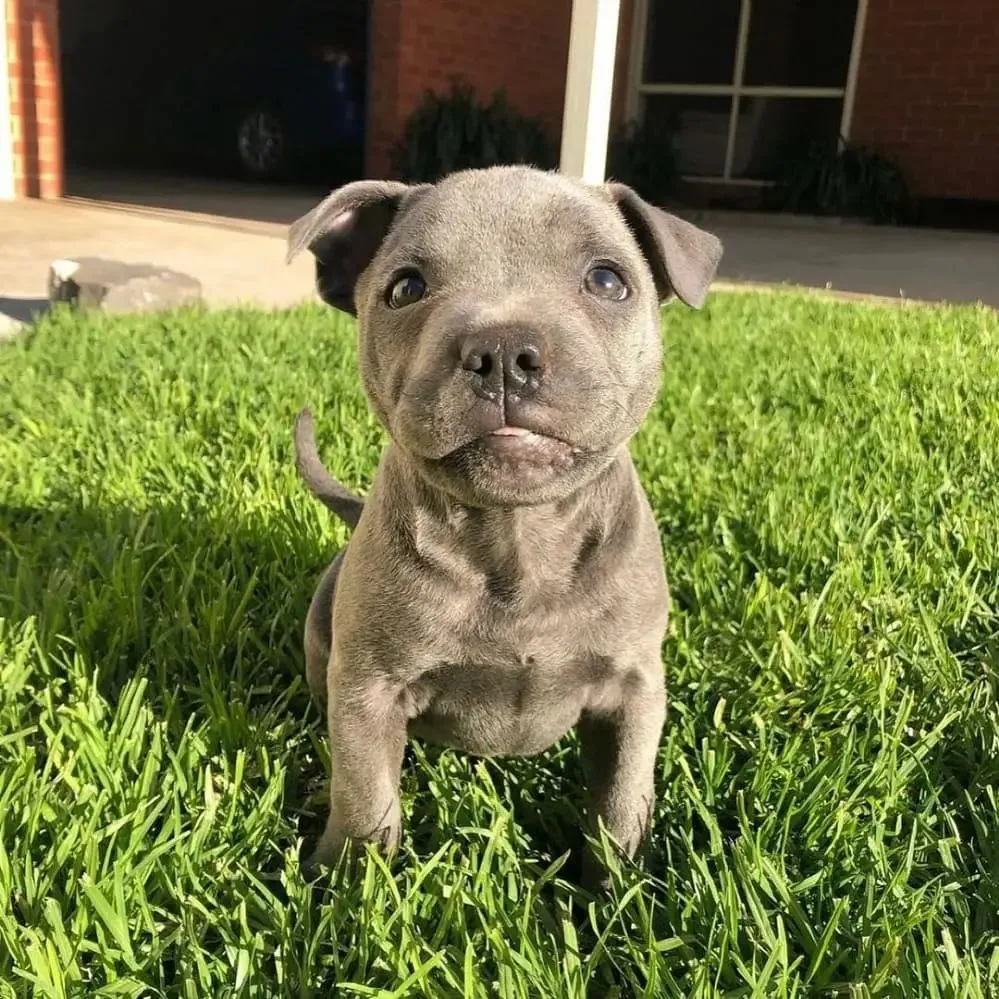
Ince Boy
Blue Available £1,500
A solid blue boy with a small white mark on his chest.
UK home delivery £200–£350 by distance, or collect in Carlisle
Meet Ince first £500 deposit reserves him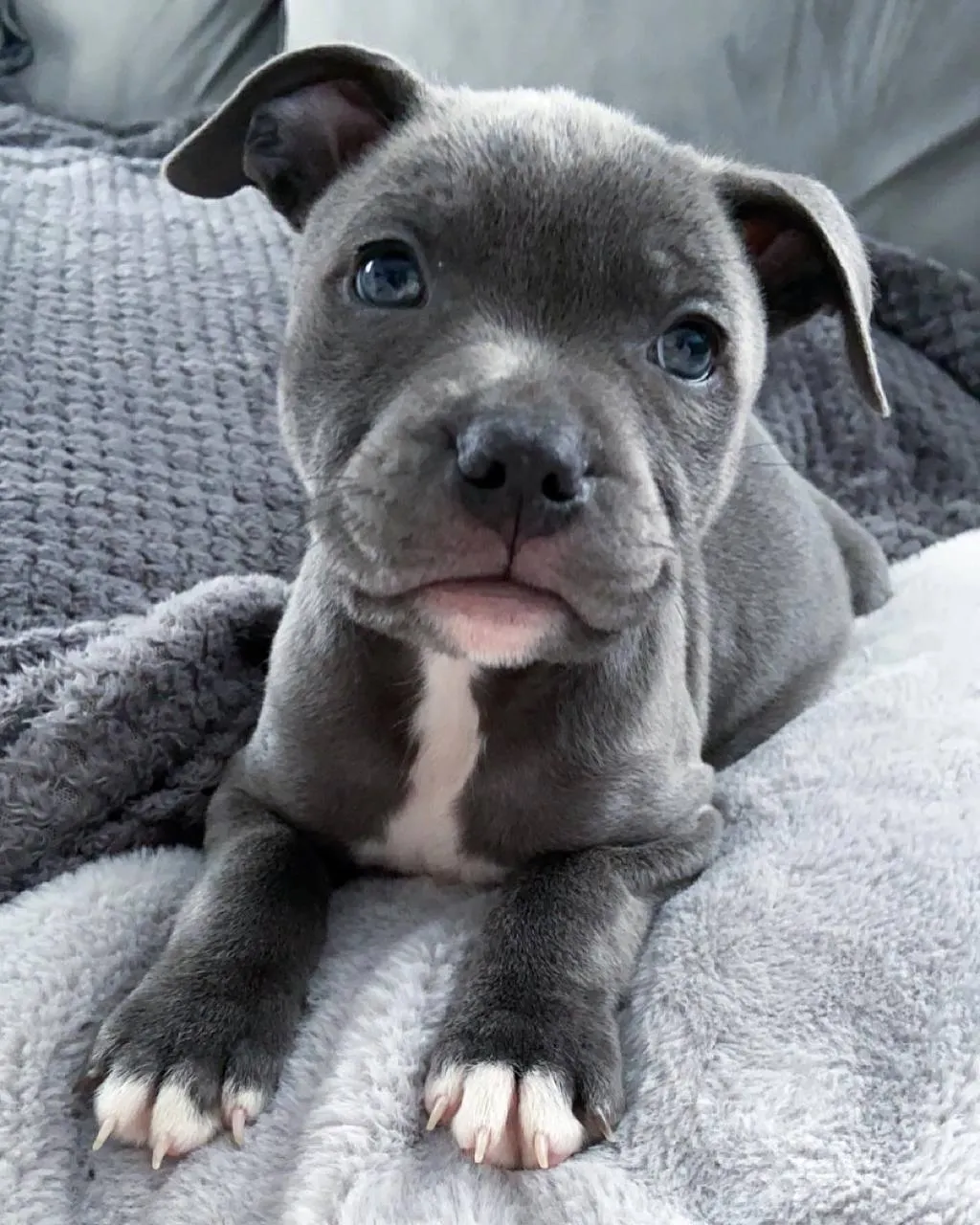
Vennie Girl
Blue with white chest Available £1,700
A blue girl with a white chest and white toes.
UK home delivery £200–£350 by distance, or collect in Carlisle
Meet Vennie first £500 deposit reserves her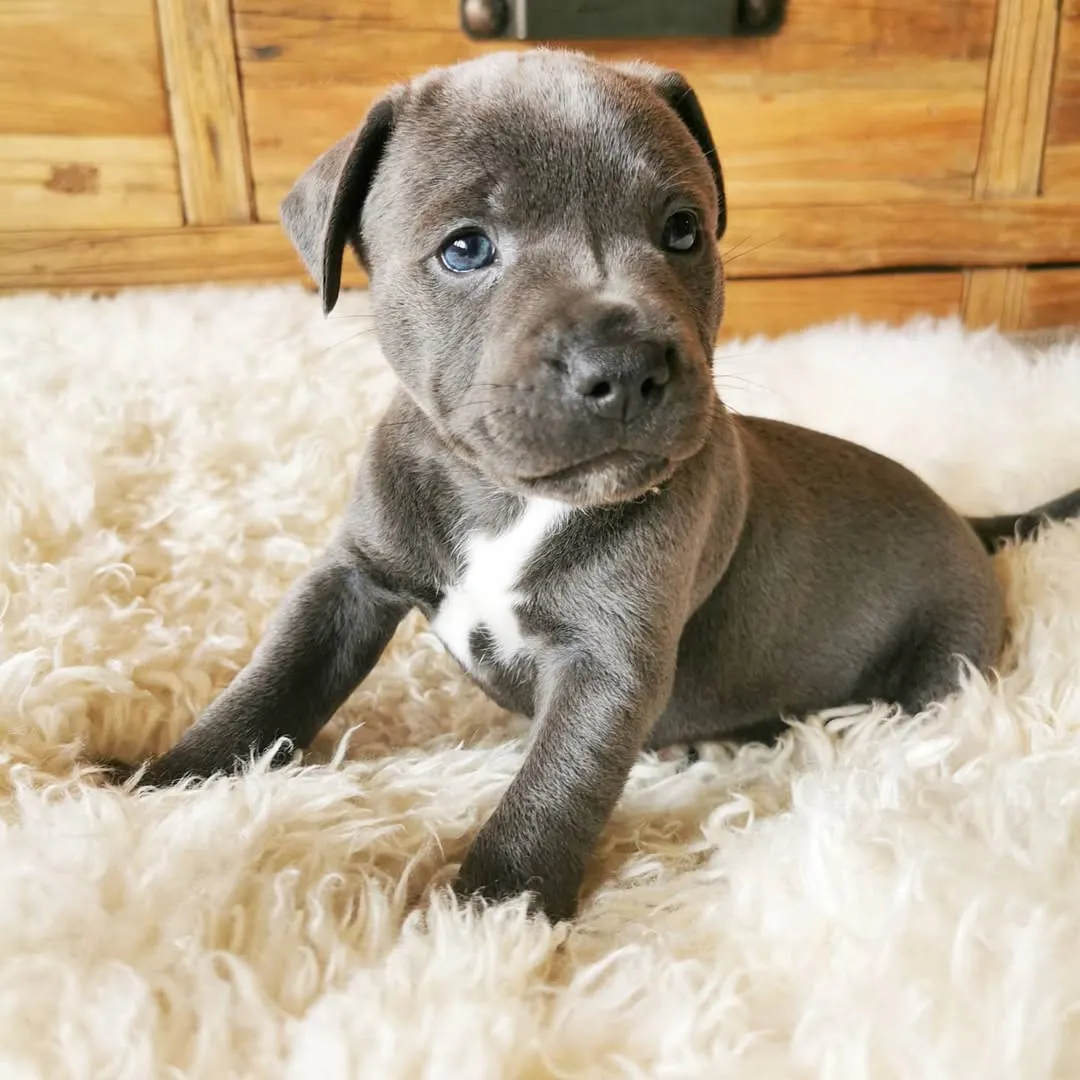
Christa Girl
Blue Available £1,700
A solid blue girl with a steady, thoughtful look, sitting up straight.
UK home delivery £200–£350 by distance, or collect in Carlisle
Meet Christa first £500 deposit reserves her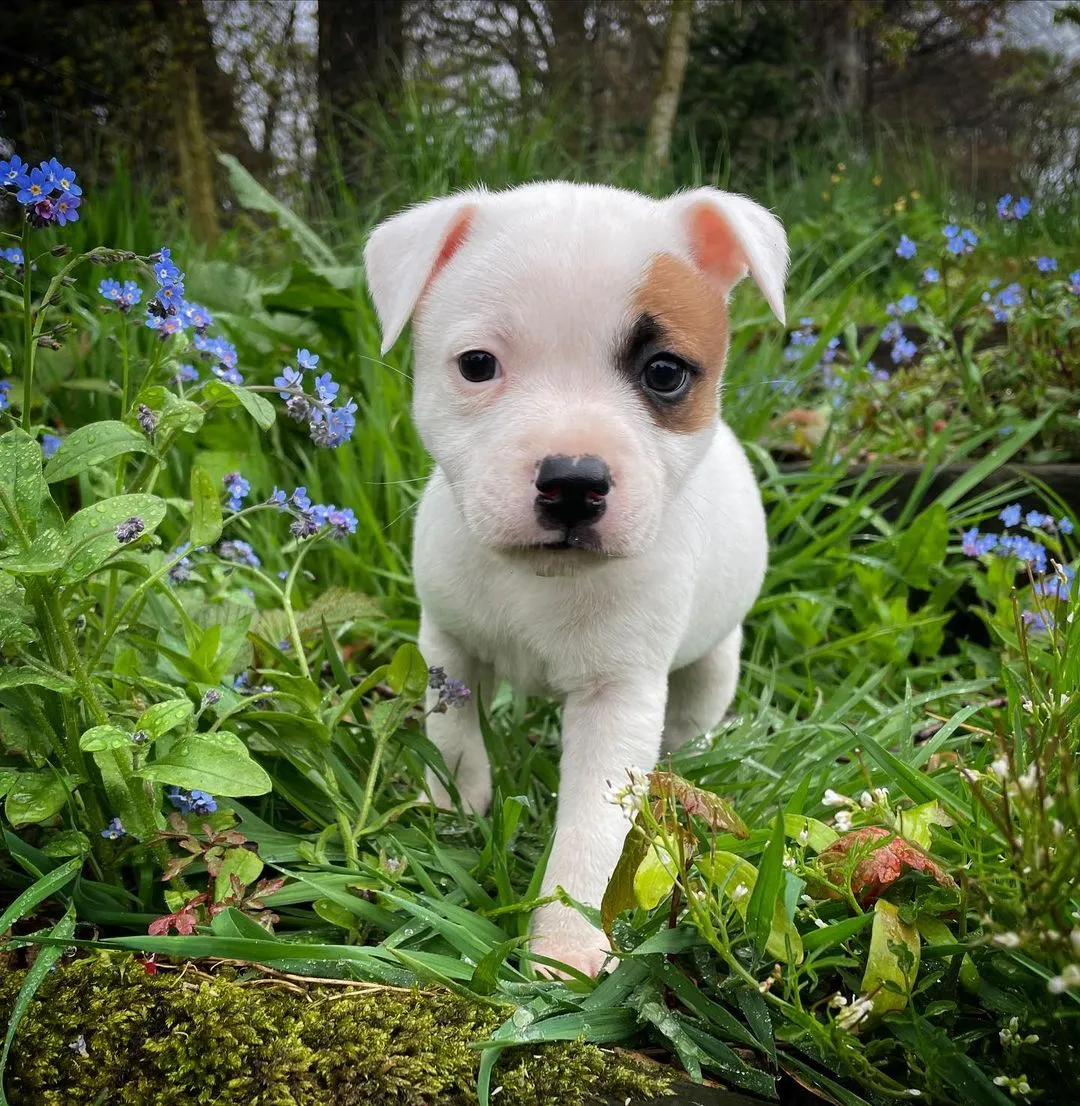
Cheryl Girl
White with tan eye patch Available £1,700
White girl, with a tan patch over her left eye and on her back.
UK home delivery £200–£350 by distance, or collect in Carlisle
Meet Cheryl first £500 deposit reserves herThe breed, the law and everyday life with a Staffy, whichever seller you choose.
Only the papers can say. An English Staffordshire Bull Terrier carries a Kennel Club registration and is judged against its own breed standard; the American Staffordshire Terrier is a separate, larger breed with its own.
No. The government's banned-dogs list names the "Pit Bull Terrier"; the Staffordshire Bull Terrier is not on it. The list goes by a dog's looks rather than its name, which is one more reason to keep your puppy's papers safe.
Yes, with an adult in the room. Pups here grow up indoors with the family and meet children before they leave, so a busy household is nothing new to them.
Among people. Every litter grows up indoors with the family in Carlisle, with the noise and visitors of a busy house, and never in a building out the back.
A flat can work. Daily walks and time in the park matter far more to a Staffy than a garden of its own does.
Not for a full working day. The PDSA says Staffies "do best when there is someone around the home all the time", so plan a walker or company at midday.
Not a well-raised one. A Staffy raised among people is a family dog at heart. Meet the parents and you see the temperament your puppy is likely to share.
Yes, with some help. A Staffy forgives a beginner's mistakes and repays short daily training, and I, Lisa Bright, stay in touch after collection here at BlueStaffyUK in Carlisle. Rather skip the puppy months? A grown rescue dog whose nature is already known is the gentler start.
Quickly, when the lessons are short. A Staffy is clever and keen to please, so a few minutes of reward-based training, twice a day, beats one long session.
Tell me which door you are weighing up and who shares your home. I reply to each enquiry in person, with what I would do in your shoes.
We use cookies to see which pages help families find us (Google Analytics) and how the site is used (Microsoft Clarity). Nothing loads until you choose. Our privacy policy