Card 1 of 6
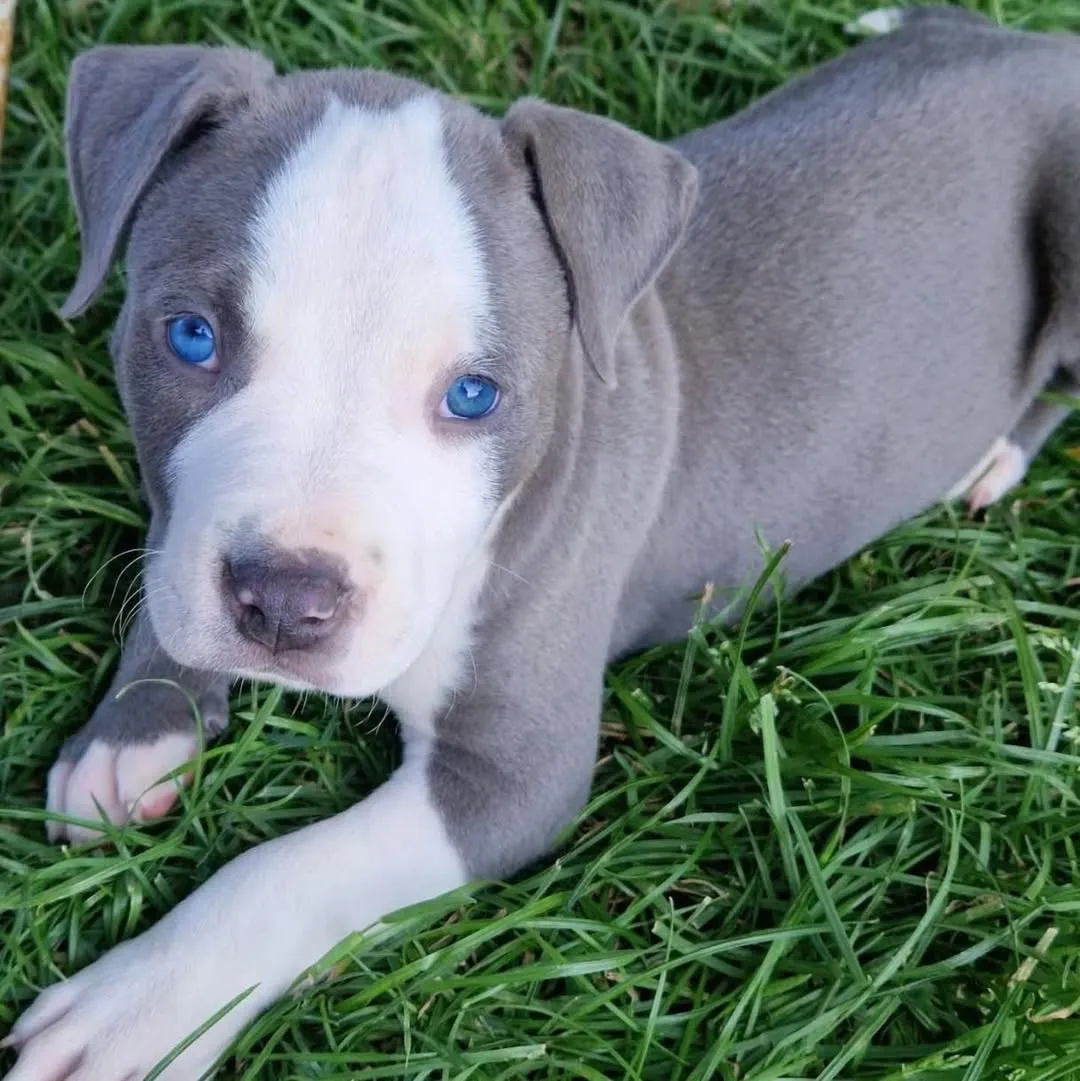
Roman's Page£1,500
- Sex
- Male
- Coat
- Blue and white
- Parents
- Maggie × Jones
- Status
- Available
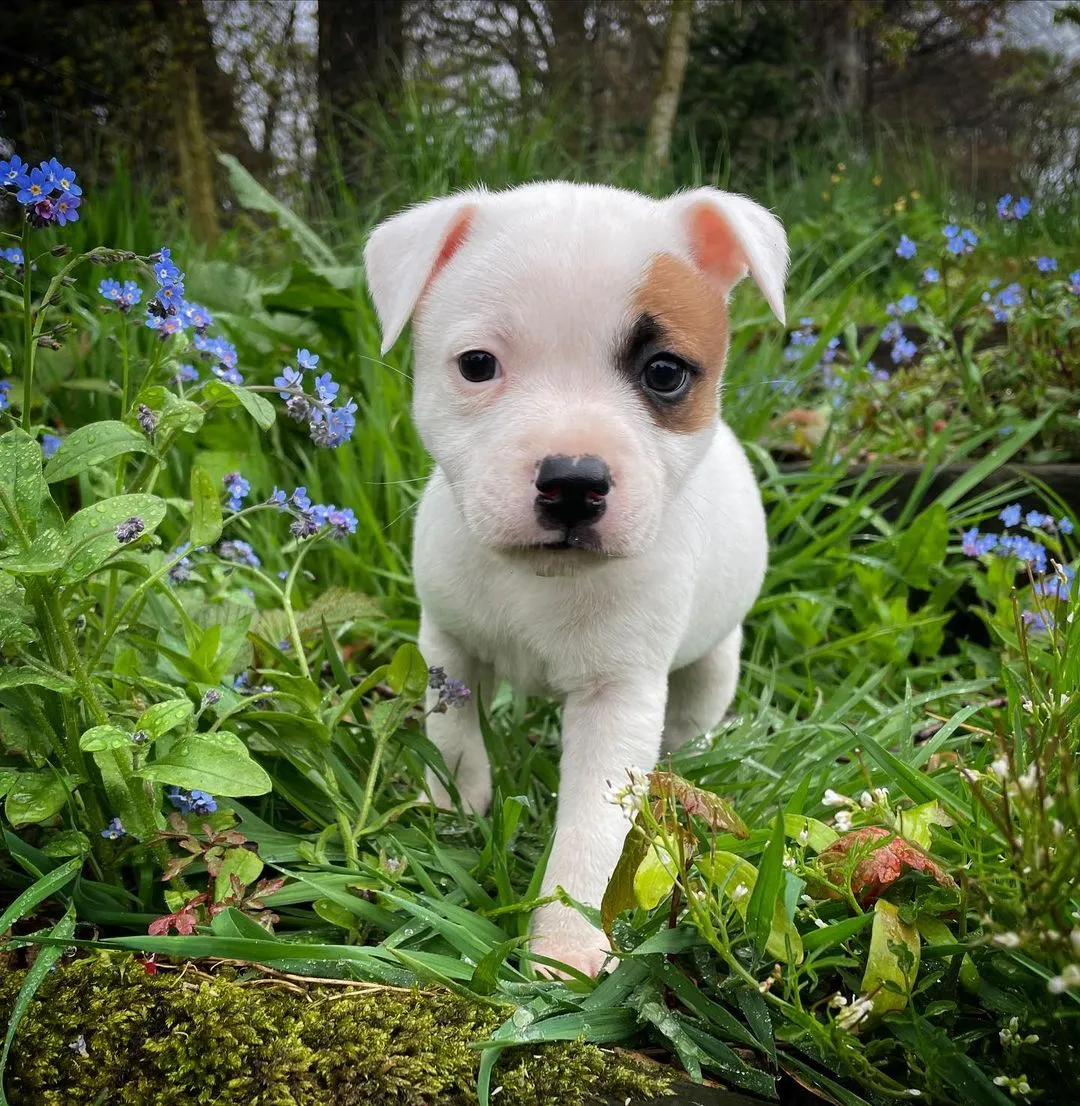
Our blue-and-white boy, happiest stretched out on the grass.
Ask About RomanKey facts
Two DNA tests, two parents, and the paperwork behind every puppy that leaves here.
Four figures, each read out of the records below.
Welcome to BlueStaffyUK, where the health and well-being of our blue Staffordshire Bull Terrier puppies are at the very heart of everything we do. For us, health is not just a phrase; it’s a foundational principle that guides every aspect of our breeding program. We understand that when you’re looking for where to buy a blue staffy puppy in the UK, you want assurance of their health and longevity.
What follows is the working rather than the promise: the two conditions a Staffordshire Bull Terrier is screened for and where Maggie and Jones stand on each, then the care that decides where in a lifespan a dog lands. Where a fact is not established it is absent — no laboratory named, no percentage anywhere.
The summary, before the working
Four lines, each with a file behind it rather than a badge.
We DNA test Maggie and Jones for L-2-HGA and HC-HSF4, the pair of inherited conditions the breed is screened for.
Every puppy is chipped before it goes, as the law has required since 2016, and the details are ready to transfer into your name.
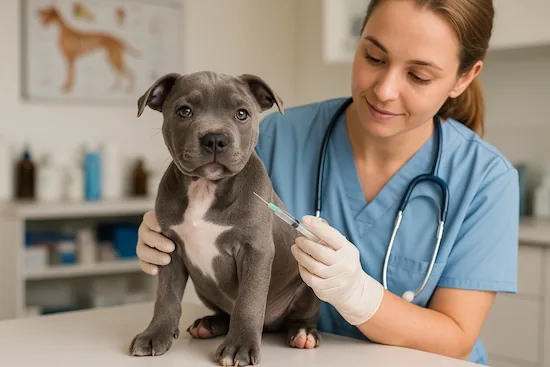
The first vaccination is done here, and the card travelling with the puppy records it beside the chip number and the vet check.
The Staffordshire Bull Terrier Club's figure for a well-cared-for dog is 12 to 14 years with good care and good genetics.
This is non-negotiable for us. Both our beloved Maggie and Jones are DNA tested clear for L-2-HGA (L-2-Hydroxyglutaric Aciduria) and HC-HSF4 (Hereditary Cataracts), and both have their eyes and elbows screened. “What does L-2-HGA testing mean?” It means we test both parents for the gene behind a serious neurological condition before we breed.
| Test | What it screens for | Maggie and Jones |
|---|---|---|
| L-2-HGA | L-2-hydroxyglutaric aciduria, a neurological disorder affecting metabolism | Clear |
| HC-HSF4 | Hereditary cataracts, an inherited eye condition | Clear |
Both conditions are recessive: a puppy needs two copies to be affected, one from each parent, which is why both parents are tested. A DNA test speaks to these two conditions and to nothing else. Ask us about the two tests before you travel.
The registry's own page on the L-2-HGA DNA test and the registry's own page on the HC-HSF4 DNA test say what each screen looks for.
Two is the number of DNA screens the breed has, so two is the number this page prints. A further test, appearing on our own site and in none of our files, would be worth nothing to you and would make the two that are real harder to trust.
The table names Maggie and Jones because a DNA test is taken by one dog. A breeder who reports testing as a house policy is reporting something no one can check against a dog. The DNA results behind that table are Maggie's and Jones's own, and we hand them to you privately once you have contacted us. They are never published, so no other breeder can borrow them as proof for a dog of theirs.
Ask any breeder which tests each parent has had, and ask to see the vet records behind the rest.

At BlueStaffyUK, our proactive approach to the importance of health screening for Staffy parents is central to our reputation as a reliable Staffordshire Bull Terrier breeder in the UK. We go above and beyond the standard, ensuring both our breeding parents, Maggie and Jones, and their puppies are thoroughly screened.
Our breeding dogs also undergo relevant BVA/KC eye examinations to check for other inherited eye diseases not covered by the HC-HSF4 DNA test, and patella grading to assess knee health.
The HC-HSF4 test covers one inherited cataract and one only; an examination by a vet on the scheme looks at the eye itself for what the DNA test cannot see. The BVA's own description of the eye scheme sets out who may carry one out.
Knee health is assessed before any mating. We state that we do it and print no grade here.
Beyond genetic tests, our parent dogs receive regular veterinary check-ups to ensure they are in peak physical condition.
Because a recessive condition is decided before a puppy exists. Once a litter is born, screening only reports; before a mating it can still change the outcome, which is why the tests here are the parents'. Read about the two parents and the home they live in if you would rather meet the dogs behind the tests first.
No scheme membership, no accreditation and no standards body. None is recorded in any file we keep, and a body named without a document behind it is a borrowed reputation.
Every screen here happens before a pairing is agreed, which makes it a decision rather than a record.
An examination has a date on it, and the date is the part that says whether it is current.
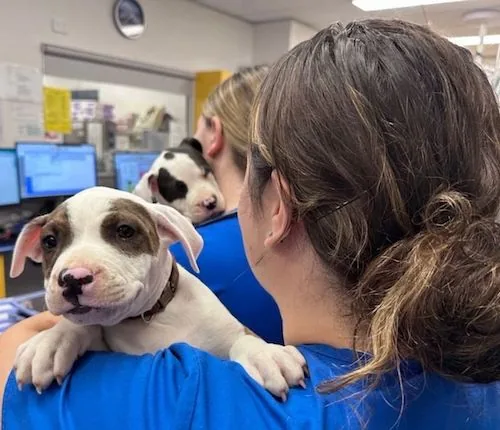
A puppy leaving here has had the first part of a course somebody else finishes: what is already done, then what your own vet does next.



Your future companion’s health journey continues even after they are born. Every blue Staffy puppy leaving BlueStaffyUK undergoes:
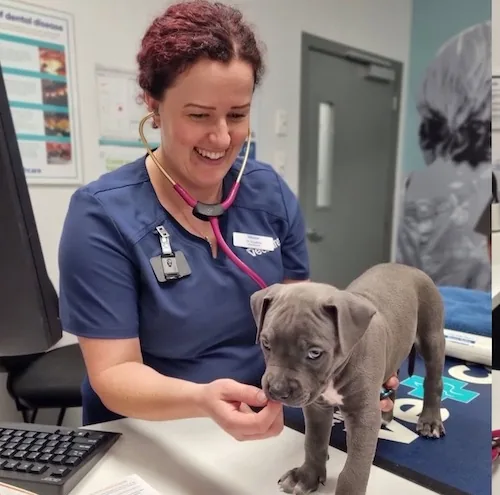
The first vaccination, against distemper, parvovirus, leptospirosis and hepatitis. The microchip. Worming and a flea treatment. A veterinary examination. And the signed card recording all four, travelling with the puppy rather than following it on.
Understanding the costs of initial puppy shots, injections, and vaccinations is essential for your blue Staffy’s health. For general advice on puppy vaccinations in the UK, the PDSA offers excellent guidance.
The second dose and the yearly booster are your vet's, and so is anything optional. The PDSA's guide to dog vaccinations is the independent account of what a full course covers.
Required by law since 2016, done before the puppy leaves. The government's guidance on the microchipping law sets out the keeper's side of it, which becomes yours on the day you collect.
Both are done here and dated on the card, so your vet picks the schedule up rather than starting it again.
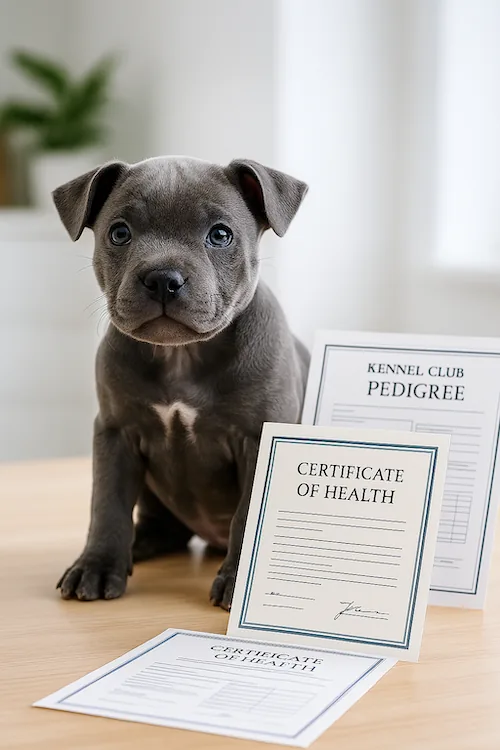
We are proud to offer a comprehensive blue Staffy health certificate with every puppy, detailing their vaccination records, microchip number, and vet health check results.
See everything that comes home with a puppy for the full list. No length of cover is stated on either page, because no file we keep holds one.
Everything on it has already happened and can be checked with the practice that did it, which is exactly why it is worth more than a sentence on a website.
The vaccination is good practice; the chip is the law, and transferring the keeper details is the part new owners most often forget.
Your vet will want the card in front of them, and the gap between doses is theirs to set.
Choosing KC-reg Staffy puppies from an ethical Staffy breeder offers a crucial layer of reassurance regarding Staffordshire Bull Terrier health tests. The Kennel Club registration provides:
Breeders who register their litters with the KC are often more invested in adhering to health testing recommendations.

Parentage, the litter, and the breeder who registered it — which is why you should be handed the original rather than a photocopy. See the parents each litter is registered to for both dogs' pedigrees.

It is not a health test and it is not a quality mark. The DNA tests higher up this page are about health; registration is a paper trail about parentage, and the two are separate documents on purpose.
Registration and health screening get quoted in the same breath more often than any other pair of claims on a breeder's website. They answer different questions, and only one of them has a result.
Both parents' registration numbers are yours on request, and the registry, not this page, is where they are worth checking.
That is the honest form of the claim in the paragraph above: a correlation worth something, and not a test result.
Ask for both by name, because a breeder holding one is not necessarily holding the other.
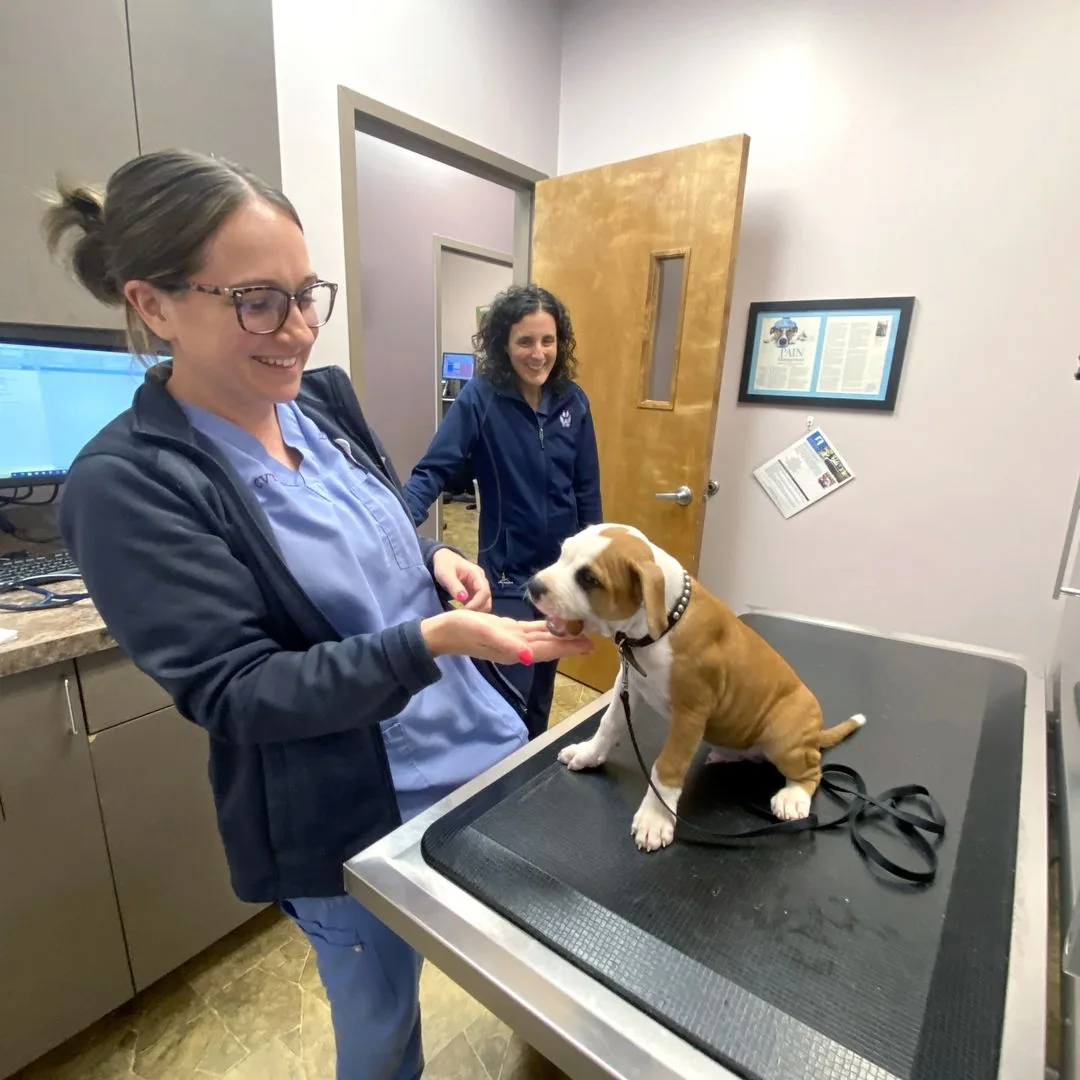
“When should I take my puppy to the vet?” Your first vet visit with your new blue Staffy puppy should be scheduled within 48-72 hours of bringing them home. This initial veterinary care for puppies allows your vet to:
Within forty-eight to seventy-two hours of coming home, and before anything is wrong: it puts your own vet's eyes on the puppy at the start rather than in an emergency.


Being attentive to your blue Staffy’s health is key to prompt treatment. While you’ll establish a great relationship with your vet, knowing when to take your pup to the vet for common Staffy health issues can make a big difference. Remember, this information is not a substitute for professional veterinary advice, but a guide to help you recognise puppy health issues early.
We are breeders. Every line above is a reason to ring a vet and none is a diagnosis we can make, which is why this section names signals and stops. The RSPCA's independent puppy advice covers the same ground, written by somebody with nothing to sell you.
Most of that list is a change rather than a symptom, so the first fortnight of learning what normal looks like for your dog is what makes any of it legible.
A phone call is free and an ignored fortnight rarely is, for you or for the puppy.
If something shows up in the first weeks we want to know, because the litter shares parents.
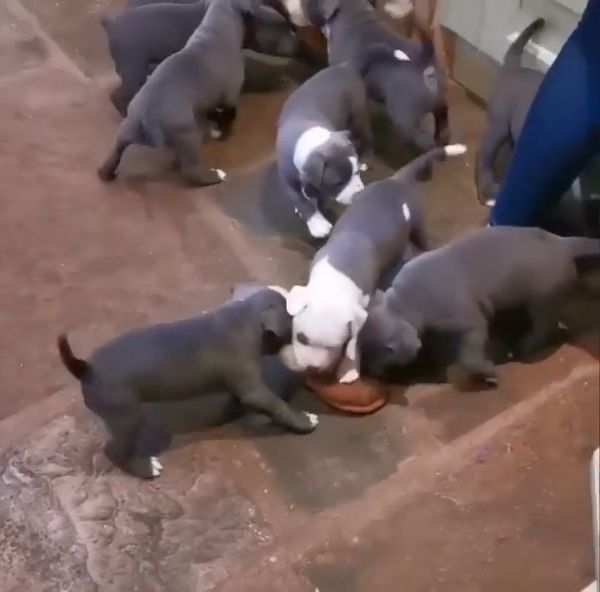
“What should I feed my new puppy?” High-quality, balanced nutrition for blue Staffy puppies is paramount for your Staffy puppy’s health and development.
The litter is weaned onto a premium puppy food and you go home knowing which one. Change it if you want to; change it over a week or so rather than in a day, because the stomach is the part that notices.
Set meals at set times rather than a bowl left down. A Staffy will eat what is in front of it, and weight is the single thing an owner controls that shortens this breed's life.
Clean water, available all the time, changed rather than topped up.



The everyday human foods a dog should not have: chocolate, grapes and raisins, onions and garlic, and anything sweetened with xylitol. Our blog guides go further on feeding a new puppy for the first fortnight in detail, which is the fiddly part.
We hold no file stating a quantity for a given weight, so this page states none; the bag and your vet both do, and one of them knows your dog.
Easy to feel and not to see is the whole of it, and it costs nothing to check weekly.
Where a Staffy is itching, the diet is worth a word with your vet before anything else.
Maintaining your blue Staffy’s health goes beyond genetic testing and routine vet visits. A holistic approach focusing on their daily life is crucial for their physical and mental well-being throughout their lives. This comprehensive care helps prevent health issues in puppies and adult dogs alike.
One to two hours a day for a grown dog: brisk walking, running in a secure space, and play. A puppy does far less than that and builds up to it, because the joints are still arriving. The figure matters for this breed in particular — a Staffy with nothing to do finds something, and the something is usually a door frame.
Puzzle feeders, short training sessions, and play with a person in it. Ten minutes of thinking tires this breed more reliably than another mile does, and it is the half most often skipped.

While Staffies have short coats, routine grooming is still important. Regular brushing with the best dog brush for Staffy coats helps with overall coat health and manages shedding. Always pay attention to nail trims, ear cleaning, and especially dog dental care, as poor dental hygiene can lead to serious health problems.
The brushing is quick and the skin underneath is the reason to do it: a blue Staffy shows irritation early, which is a gift if somebody is looking.
Dental disease is slow, ordinary and preventable, and it is worth a minute a day.
Split the hour and the dog settles better between them, which is what you are after.
Wondering whether you can see the health certificates before you pay? Ours reach you as soon as you make contact with us.
The Staffordshire Bull Terrier is, by nature, a robust and resilient breed known for its vitality and affectionate spirit. However, like all breeds, they can be predisposed to certain hereditary health conditions. A reputable blue staffy breeder will be fully transparent about these issues and actively work to minimise their occurrence through careful breeding and by keeping the inbreeding coefficient (COI) low.
Many new owners ask: “Are Blue Staffies prone to health issues?” The truth is, while KC-registered Staffordshire Bull Terriers are generally healthy, there are some breed-specific conditions to be aware of.

A neurological disorder affecting metabolism.
The first of the two DNA tests in the table above.

An inherited eye condition that can lead to blindness.
The second, recorded in the same table.
A kneecap that slips out of its groove. It is graded by a vet rather than screened by DNA, which is why it is in the screening section and not the table.
Blue Staffies are sometimes prone to skin allergies. Symptoms include itching, redness, or hair loss. A balanced diet, gentle grooming products, and vet-recommended treatments can help manage these issues.

A skin mite most dogs carry harmlessly, which can flare in a young or run-down dog — a veterinary diagnosis, and the last condition this page names. Our breed guide covers the build and temperament behind these if you would rather read the breed described than its risks listed.
No percentage, prevalence or prognosis appears beside any of the five: we hold no figure we could stand behind.
The Kennel Club's own health information for the breed keeps the breed-wide picture, which is not ours to summarise.
Naming what can go wrong is what separates a health page from a sales page, and only one of the four breeder pages we read does it at all. It describes a breed, not your dog.
The other three are managed rather than screened, which is why the care sections exist.
Your vet knows it already, and it makes the conversation about your dog faster.
This is the question behind all the others on the page, and the answer is a range rather than a number. Everything above decides where in it a dog lands.
12 to 14 years with good care and good genetics — the Staffordshire Bull Terrier Club's figure, and the same one our breed guide carries in its own facts table. It describes a well-cared-for dog, which is the part of the sentence doing the work.
Diet, daily exercise and regular vet checks: the three this page has already covered, gathered here as what the figure actually depends on. No promise attaches to any of them, and none is worth a number we cannot evidence.
Ours is a two-year health guarantee, a promise we make about our own puppies. A breed club's lifespan range describes Staffies in general; it promises nothing about yours.
Screening decides what a litter starts with; the years after that belong to your house.
Of everything an owner decides, it is the one most reliably tied to how long a Staffy lives.
One buyer, named, on what actually arrived with his puppy.
After extensive research, we chose BlueStaffyUK, and we’re so glad we did. Our blue Staffy puppy arrived happy and healthy, with all his papers and medical records meticulously organized. Their commitment to ethical breeding and health testing truly shines through. He’s exactly what we wanted: loyal, intelligent, and incredibly affectionate. We highly recommend them if you’re looking to buy a Staffordshire Bull Terrier in the UK.
Every claim above this line is about a document. He is the only person on this site who has described receiving one, which is why he is the review the health page carries.
Here are some frequently asked questions regarding Staffordshire Bull Terrier genetic health and our breeding practices:
Eight of these are in the exact words they were put to us, and the ninth is what people write in about. Each answer restates something evidenced further up rather than adding to it.
A comprehensive puppy package: the first vaccinations, a microchip, a full veterinary health check, deworming and defleaing, the relevant paperwork, and a puppy pack to help them settle in.
Yes. Our parent Staffordshire Bull Terrier dogs are DNA tested for key hereditary conditions like L-2-HGA and HC-HSF4, which are the primary hereditary conditions in blue Staffies, and both have their eyes and elbows screened.
L-2-HGA testing (L-2-hydroxyglutaric aciduria) is a crucial genetic screen for Staffies. It looks for the gene behind a severe neurological disorder that affects the brain, spinal cord, and muscles. It’s a key indicator of responsible breeding for health .
Our blue Staffy puppies receive their first set of core puppy vaccinations in the UK (often against distemper, parvovirus, leptospirosis and hepatitis) before leaving us, as part of the UK vaccination schedule for Staffy puppies . We provide a comprehensive vet-signed health card detailing their vaccination history.
Yes, every KC registered Staffy puppy comes with a full blue Staffy health certificate , including detailed vet records of their initial health check, vaccinations, and deworming schedule. This provides a clear overview of their early initial veterinary care for puppies .
We recommend continuing with the high-quality puppy food your Staffy has been raised on initially (we provide a starter pack). This is one of the best ways to keep your Staffy puppy healthy. Your vet can provide long-term advice on the best diet for Staffordshire Bull Terrier puppies based on their individual needs.
Yes. KC registration, combined with breeder DNA testing, reduces the chances of hereditary issues being passed down.
A healthy, well-cared-for Staffordshire Bull Terrier can live 12–14 years , according to the Staffordshire Bull Terrier Club .
See the mother with the litter in the home the puppies were raised in, ask for the original registration papers rather than copies, find out which tests were run on each parent, and read the written contract before you pay anything beyond a deposit. A seller who will only meet you away from the premises, or who cannot produce the paperwork on the day, is a puppy farm until proved otherwise.
Every answer restates something set out at length above, deliberately: a fact appearing only inside an accordion would be a fact we were keeping quiet about.
Our guarantee covers health issues and birth defects from the day your puppy comes home. Ask us for the full wording before you pay a deposit.
No accordion describes a particular dog in a particular house; write and we will answer yours.
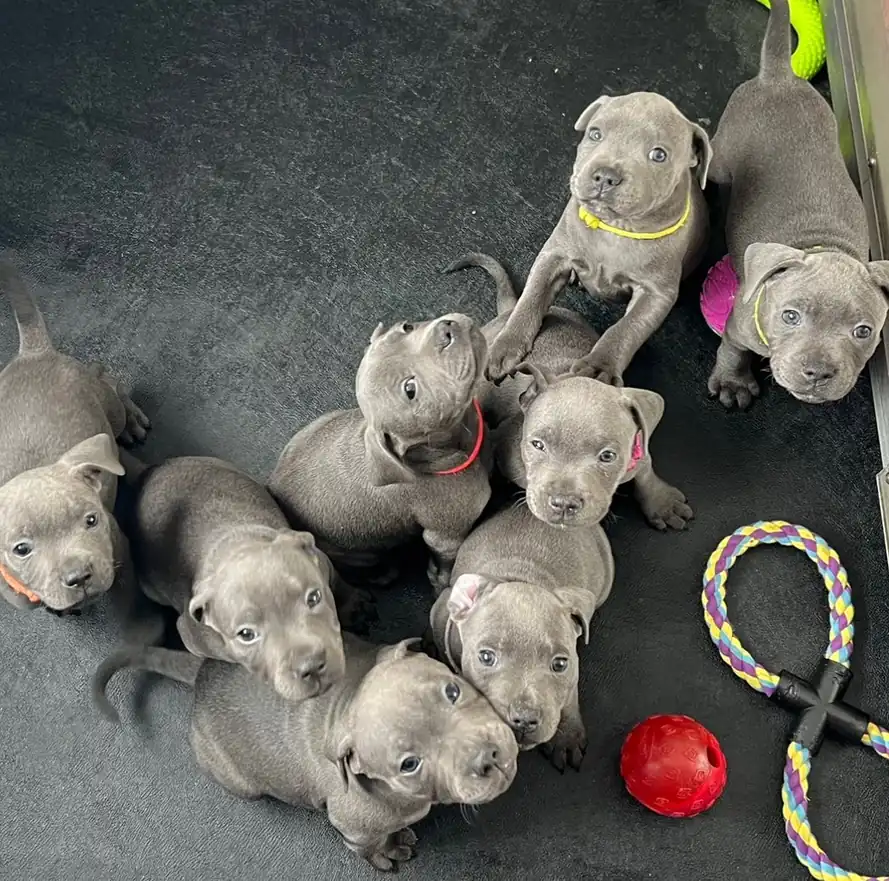
All of them are from Maggie and Jones, the two parents in the table above. Every puppy leaves us with the same papers, listed once here so each card can stay short.
Card 1 of 6
Our blue-and-white boy, happiest stretched out on the grass.
Ask About RomanCard 2 of 6
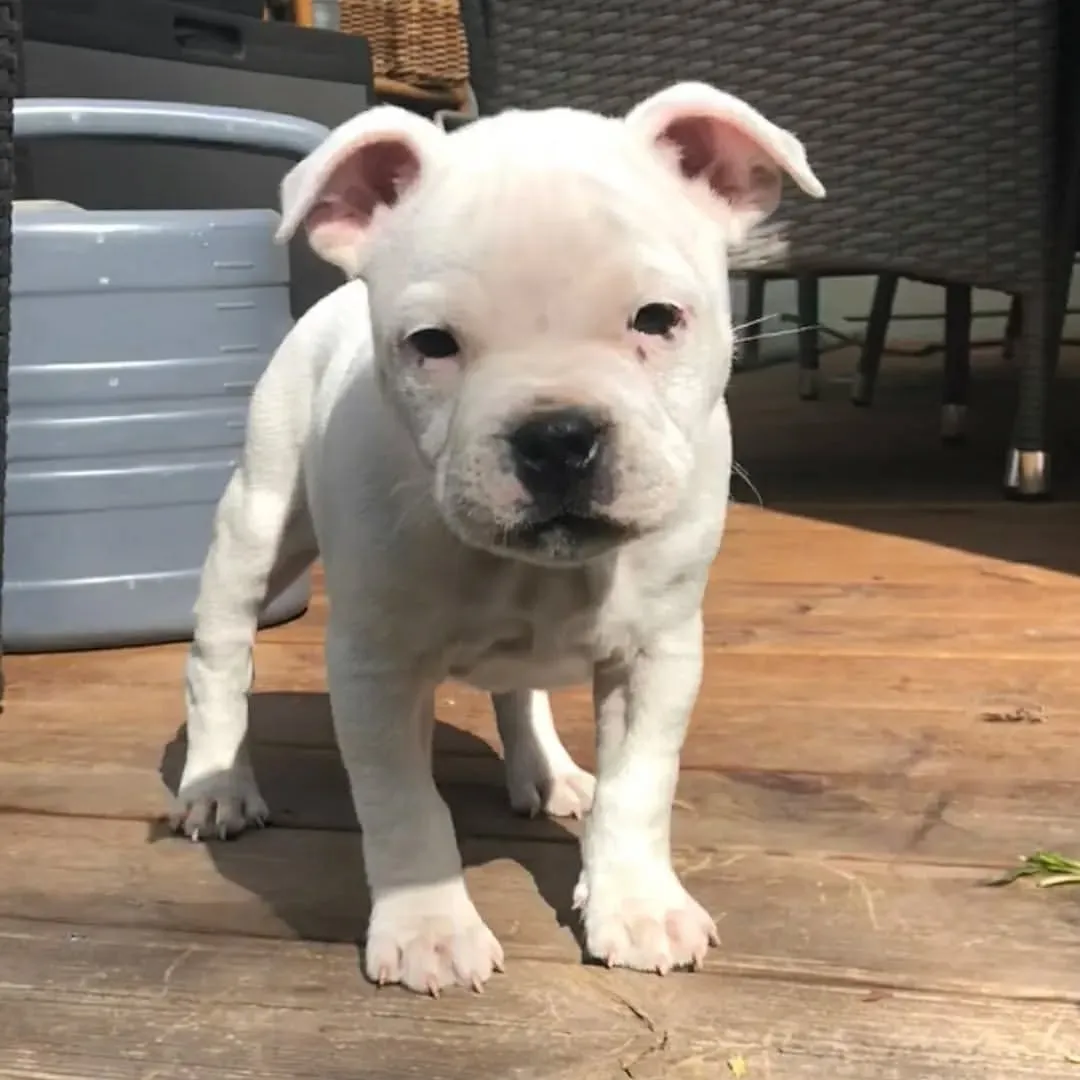
Our sturdy white boy, first to trot over and see who's come in.
Ask About ByrdCard 3 of 6
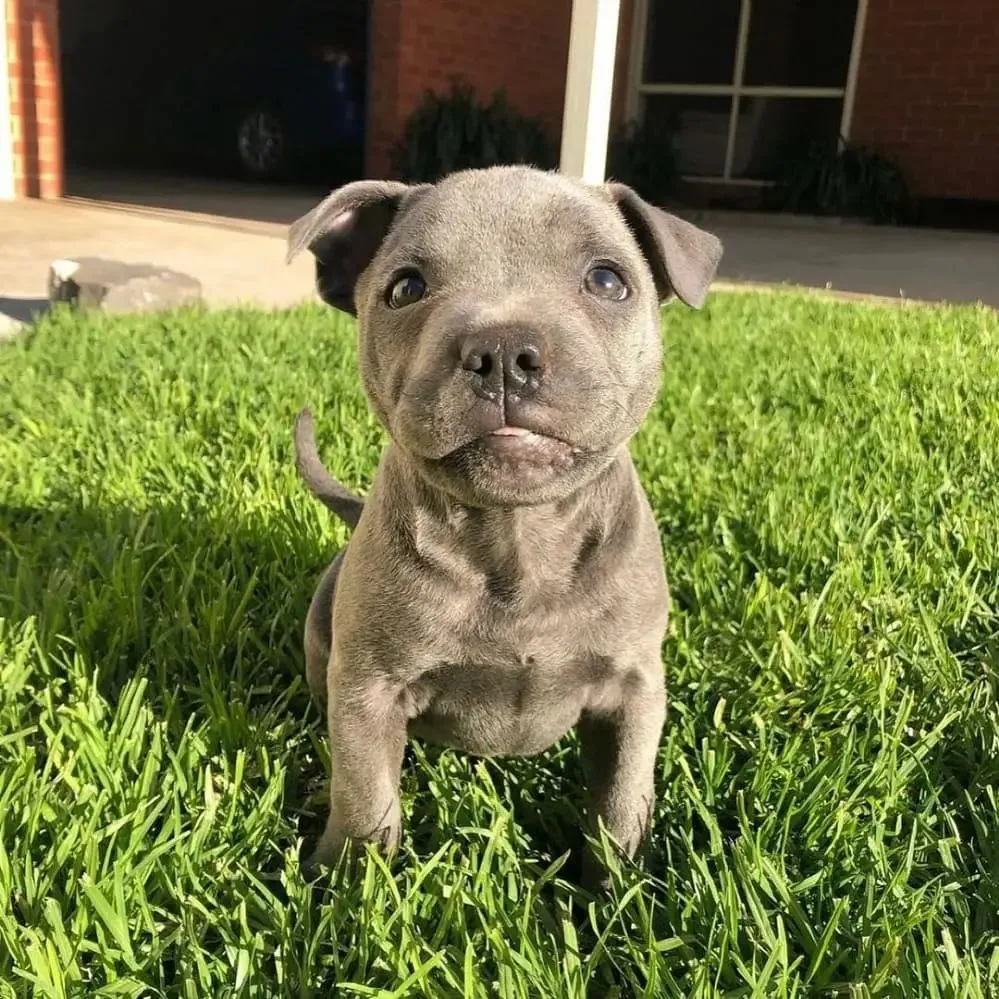
A solid blue boy with a small white mark on his chest.
Ask About InceCard 4 of 6
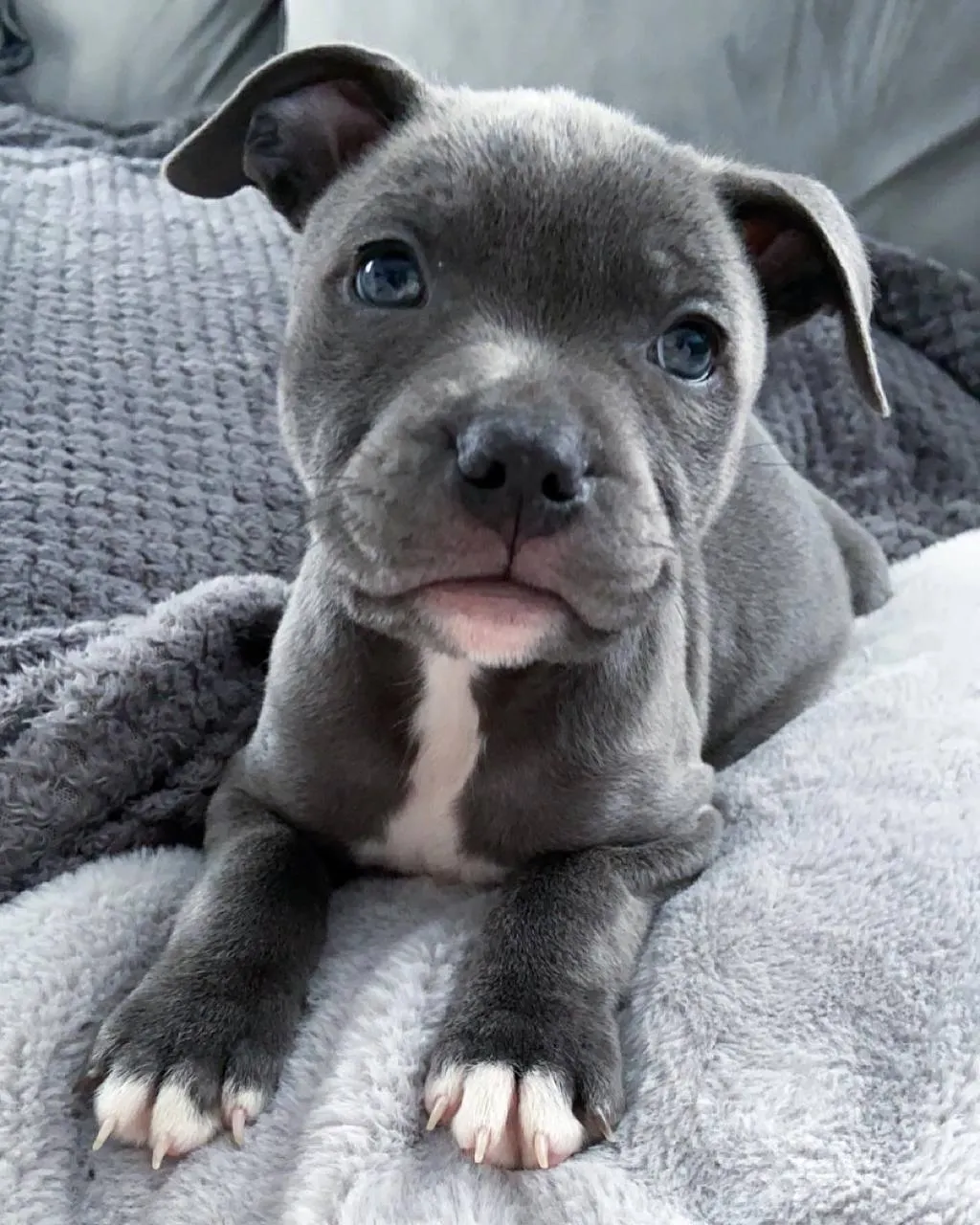
A blue girl with a white chest and white toes.
Ask About VennieCard 5 of 6
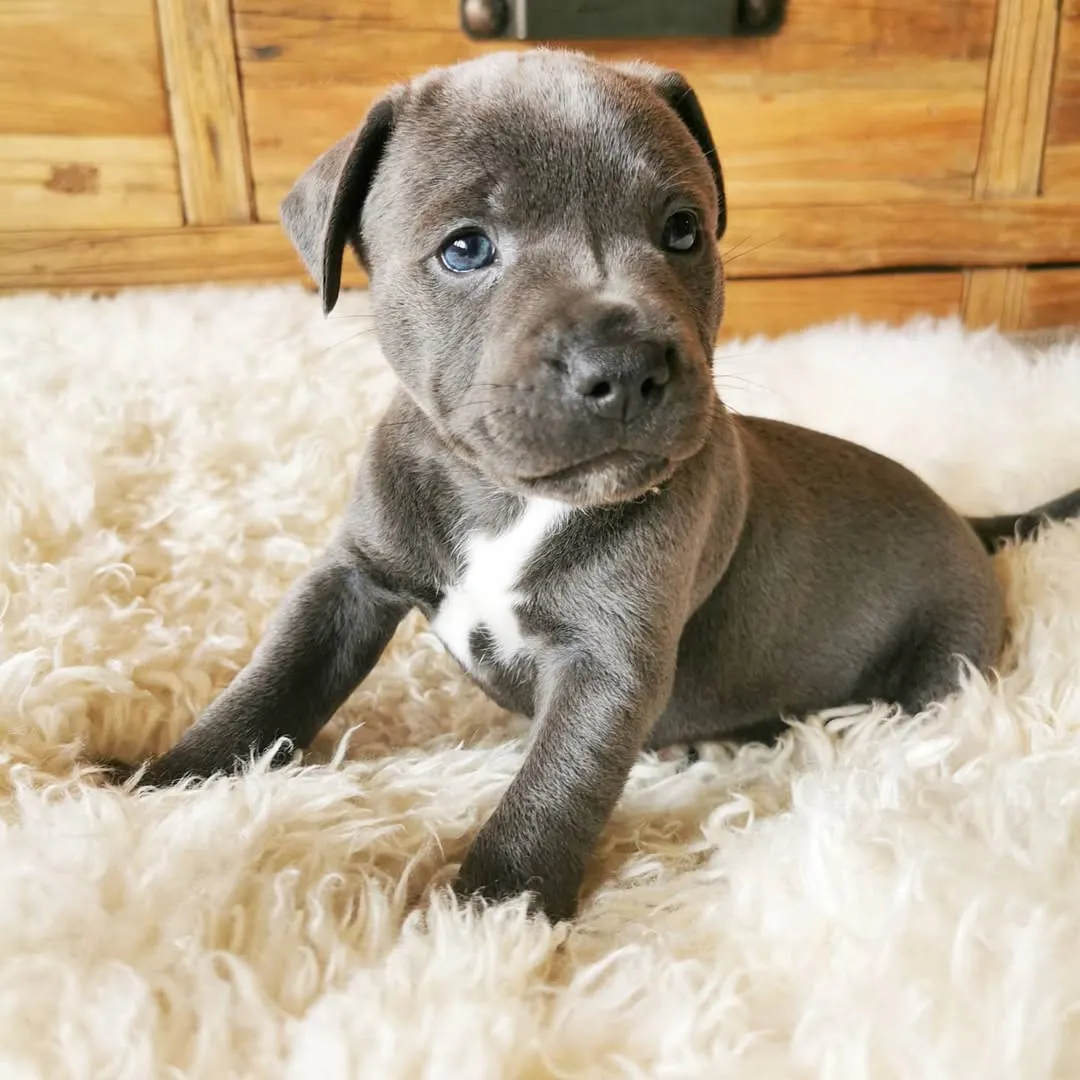
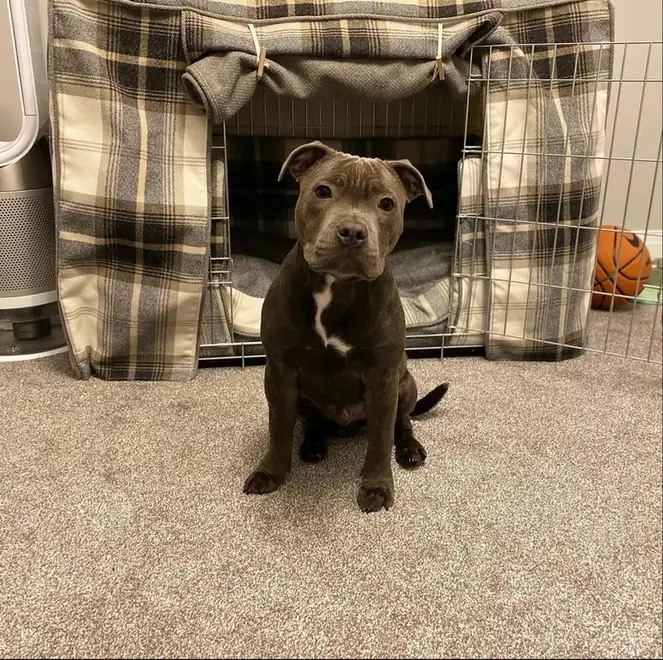
A solid blue girl with a steady, thoughtful look, sitting up straight.
Ask About ChristaCard 6 of 6
White girl, with a tan patch over her left eye and on her back.
Ask About CherylUK home delivery £200–£350 by distance, or collect in Carlisle
Choosing a blue Staffy puppy from BlueStaffyUK means choosing a companion whose health and well-being have been prioritised from day one. Our commitment, as trusted blue Staffy breeders, to our puppies’ health ensures you’re bringing home a happy, robust, and loving family member.
A puppy is £1,500 for Roman, Byrd and Ince and £1,700 for Vennie, Christa and Cheryl. The deposit is £500, up to 70% refundable if you change your mind up to 1 day before collection or delivery, and it holds one named dog. See the prices and what is included for the full table and what the balance covers.
Write to us and ask for the health paperwork, and the registration papers and the vaccination card can be in front of you before anybody pays anything. The form at the foot of this page goes to Lisa Bright, who raises the litter and reads it 24 hours a day, and no telephone number is published until there is one to publish.
When you choose a blue Staffy puppy from BlueStaffyUK, you’re not just buying a blue Staffy puppy in the UK; you’re investing in a lifetime of healthy companionship.
Reading the paperwork at home costs you a message and saves you a drive to Carlisle, and we would far rather send it twice than have you take this page's word for it.
Until a deposit is placed against a named dog, nothing at all has been held for anyone.
They travel with the puppy, and they belong to the dog rather than to us.
We use cookies to see which pages help families find us (Google Analytics) and how the site is used (Microsoft Clarity). Nothing loads until you choose. Our privacy policy